
Explanatory Notes to Legislative Proposals Relating to the Income Tax Act and Regulations (Technical Amendments)
Preface
These explanatory notes are provided to assist in an understanding of legislative proposals relating to the Income Tax Act and Income Tax Regulations. These explanatory notes describe the proposed amendments, clause by clause, for the assistance of Members of Parliament, taxpayers and their professional advisors.
The Honourable Chrystia Freeland, P.C., M.P.,
Deupty Prime Minister and Minister of Finance
These notes are intended for information purposes only and should not be construed as an official interpretation of the provisions they describe.
Table of Contents
| Clause in Legislative Proposals | Section Amended | Topic |
|---|---|---|
| Legislative Proposals Relating to Income Tax | ||
| Income Tax Act | ||
| 1 | 8 | Deductions |
| 2 | 12 | Inclusions |
| 3 | 13 | Definitions |
| 4 | 15 | Shareholder debt |
| 5 | 18.2 | Definitions |
| 6 | 56 | Amounts to be included in income for year |
| 7 | 62 | Moving expenses of students |
| 8 | 66.7 | Change of control |
| 9 | 81 | Ship of resident corporations - gains |
| 10 | 87 | Public corporation |
| 11 | 95 | Definitions for this Subdivision |
| 12 | 104 | Reference to trust or estate |
| 13 | 107.4 | Application of paragraph (1)(a) |
| 14 | 110 | Employee options |
| 15 | 110.6 | Definitions - "qualified small business corporation share" |
| 16 | 112 | Loss on share held by trust |
| 17 | 115 | Non-resident persons — 2010 Olympic and Paralympic Winter Games |
| 18 | 117.1 | Annual adjustment |
| 19 | 118 | Definitions - "pension income" |
| 20 | 120.4 | Definitions - "excluded amount" |
| 21 | 122.91 | Training amount limit |
| 22 | 126 | Former resident — deduction |
| 23 | 127.42 | Deemed rebate in respect of fuel charges |
| 24 | 127.52 | Adjusted taxable income determined |
| 25 | 128.1 | Post-emigration loss — reassessment period |
| 26 | 146 | Registered Retirement Savings Plans |
| 27 | 146.3 | Registered Retirement Income Funds |
| 28 | 146.5 | Advanced Life Deferred Annuity |
| 29 | 146.6 | First Home Savings Account |
| 30 | 147 | Definitions - "deferred profit sharing plan" |
| 31 | 147.1 | Notice of revocation |
| 32 | 147.4 | RPP annuity contract |
| 33 | 149.1 | Exclusions |
| 34 | 150 | Returns |
| 35 | 152 | Assessment |
| 36 | 153 | Withholding |
| 37 | 160.1 | Where excess refunded |
| 38 | 160.2 | Rules applicable |
| 39 | 163 | Repeated failure to report income |
| 40 | 164 | Refunds |
| 41 | 169 | Disposition of appeal on consent |
| 42 | 183.3 | Tax on Repurchases of Equity |
| 43 | 183.4 | Return |
| 44 | 188 | Revocation tax |
| 45 | 205 | Definitions - "excess ALDA transfer" |
| 46 | 207.04 | Both prohibited and non-qualified investment |
| 47 | 207.5 | Definitions |
| 48 | 211.8 | Disposition of approved share |
| 49 | 212 | Tax |
| 50 | 212.1 | Trusts and partnerships look-through rule |
| 51 | 214 | Standby charges and guarantee fees |
| 52 | 215 | Withholding and remittance of tax |
| 53 | 220 | Date of late election, amended election or revocation |
| 54 | 222 | Limitation period restarted |
| 55 | 241 | Provision of information |
| 56 | 248 | Definitions |
| 57 | 260 | Non-disposition |
| Income Tax Regulations | ||
| 58 | ITR 204.2 | Additional Reporting - Trusts |
| 59 | ITR 600 | Elections |
| 60 | ITR 1000 | Property Dispositions |
| 61 | ITR 1000.1 | Realization of Options |
| 62 | ITR 1101 | Businesses and Properties |
| 63 | ITR 1400 | Non-Life Insurance Business |
| 64 | ITR 2301 | Principal Residences |
| 65 | ITR 4301 | Prescribed Rate of Interest |
| 66 | ITR 5600 | Prescribed Distributions |
| 67 | ITR 5907 | Interpretation |
| 68 | ITR 6400 | Child Tax Credits |
| 69 | ITR 6701 | Prescribed Venture Capital Corporations, Labour sponsored Venture Capital Corporations, Investment Contract Corporations, Qualifying Corporations and Prescribed Stock Savings Plans |
| 70 | ITR 6702 | Prescribed Venture Capital Corporations, Labour sponsored Venture Capital Corporations, Investment Contract Corporations, Qualifying Corporations and Prescribed Stock Savings Plans |
| 71 | ITR 6802 | Prescribed plan or arrangement |
| 72 | ITR 8308 | Conditions — Retroactive Contributions |
| 73 | ITR 8502 | Permissible Contributions |
| 74 | ITR 8503 | Defined Benefit Provisions |
| 75 | ITR 8506 | Money Purchase Provisions |
| 76 | ITR 8512 | Registration and Amendment |
| 77 | ITR 8513 | Designated laws |
| 78 | ITR 9002 | Prescribed Property not Mark-to-Market Property |
Income Tax Act
Clause 1
Expenses of railway employees
Income Tax Act (the Act or ITA)
8(1)(e)
Paragraph 8(1)(e) permits a railway employee to deduct amounts expended for the purpose of earning income from employment in respect of meals and lodging under certain circumstances. The deduction of an amount under this provision is only allowed to the extent that the employee was not reimbursed and was not entitled to be reimbursed for the amount.
Paragraph 8(1)(e) is amended to provide that no deduction is allowed for an amount in respect of which the employee received a non-taxable allowance or is entitled to receive such an allowance.
Transport employee's expenses
ITA
8(1)(g)
Paragraph 8(1)(g) permits a transport employee to deduct amounts expended for the purpose of earning income from employment in respect of meals, lodging and travel under certain circumstances. The deduction of an amount under this provision is only allowed to the extent that the employee was not reimbursed and was not entitled to be reimbursed for the amount.
Paragraph 8(1)(g) is amended to provide that no deduction is allowed for an amount in respect of which the employee received a non-taxable allowance or is entitled to receive such an allowance.
Also, the French version of paragraph 8(1)(g) is amended to better align the English and French versions.
Clause 2
Refunds
ITA
12(1)(z.6)
Paragraph 12(1)(z.6) requires the inclusion in income of any amount received by the taxpayer in the year in respect of a refund of an amount that was deducted under paragraph 20(1)(vv) in computing income for any taxation year.
The French version of paragraph 12(1)(z.6) is amended to better align the English and French versions.
Definition of flipped property
ITA
12(13)(b)(i.1)
Subsection 12(13) of the Act provides the definition of "flipped property" of a taxpayer. Paragraph 12(13)(b) provides exclusions to the definition of "flipped property" in certain circumstances. For example, subparagraph 12(13)(b)(i) provides an exclusion for property owned by the taxpayer for less than 365 consequence days prior to its disposition where the disposition can reasonably be considered to occur due to, or in anticipation of, the death of the taxpayer or a person related to the taxpayer.
Under existing paragraph 12(13)(b), where the taxpayer is a trust, a deemed disposition by the taxpayer as a consequence of paragraph 104(4)(a) of the Act would be captured by the definition of "flipped property". A beneficiary under a trust is not related to the trust. The death of the beneficiary, whose death triggers the deemed disposition under paragraph 104(4)(a), is not the death of a person related to the taxpayer, and therefore does not trigger the exclusion provided in subparagraph 12(13)(b)(i).
Paragraph 12(13)(b) is amended to add an exclusion in new subparagraph 12(13)(b)(i.1) for a deemed disposition by a trust as a consequence of paragraph 104(4)(a).
This amendment applies in respect of dispositions that occur on or after January 1, 2023.
Clause 3
Definitions
ITA
13(21)
French Definition - "fraction non amortie du coût en capital"
Subsection 13(21) contains a number of definitions, including the definition "undepreciated capital cost", that apply for purposes of section 13. The definition "undepreciated capital cost" in that subsection also applies for purposes of the Act by operation of subsection 248(1).
The undepreciated capital cost to a taxpayer of depreciable property of a prescribed class as of any time means the amount determined by the formula in that definition.
The French version of the description of E in that formula is amended to better align the English and French versions.
Clause 4
Shareholder debt
ITA
15(2)
Subsection 15(2) requires that certain indebtedness be included in the income of the debtor in the year in which the indebtedness arose. This subsection is intended to prevent a debtor, that is directly or indirectly a shareholder of a particular corporation or that is connected with a shareholder of the particular corporation, from avoiding tax by receiving property from the corporation through an otherwise non-taxable loan, rather than as a dividend or other taxable amount.
Certain debtors are excluded from the application of subsection 15(2), including a corporation resident in Canada (CRIC) and a partnership, each member of which is a CRIC. Subsection 15(2) is amended to relocate these exclusions to new subsection 15(2.01) following the addition of a new exception for tiered partnerships in new paragraph 15(2.01)(b). See the commentary to subsection 15(2.01) for more information.
This amendment applies to loans received and indebtedness incurred after October 31, 2011.
Excluded persons and partnerships
ITA
15(2.01)
Subsection 15(2) requires that certain indebtedness be included in the income of the debtor in the year in which the indebtedness arose. Certain debtors are currently excluded from the application of subsection 15(2), including a corporation resident in Canada (CRIC) and a partnership, each member of which is a CRIC. Subsection 15(2) is not intended to apply to loans received by a partnership, that is held directly or indirectly, solely by CRICs.
New subsection 15(2.01) is established to compile a list of debtors to which subsection 15(2) does not apply. These debtors are:
- CRICs; and
- partnerships, each member of which is either a CRIC, or another partnership described here (to accommodate tiered-partnership structures).
Consequently, subsection 15(2) will not apply to a partnership if all the members are, directly or indirectly (through one or more other partnerships), CRICs.
Example – tiered-partnership structure
Relevant facts:
- two CRICs (Canco1 and Canco2) are the only members of a foreign partnership (Foreign LP1);
- Canco1 and Foreign LP1 are the only members of another foreign partnership (Foreign LP2);
- Foreign LP2 wholly owns a foreign corporation (FA); and
- Canco2 makes a loan to Foreign LP2 in the year.
Tiered-partnership structure

Since Foreign LP2 is a shareholder of a particular corporation (FA), and Foreign LP2 has received a loan from a corporation related to FA (Canco2), in the absence of new subsection 15(2.01), subsection 15(2) would apply to include the amount of the loan in computing the income of Foreign LP2 for the year.
However, Foreign LP2 is a partnership described in new paragraph 15(2.01)(b) because each member of the partnership is a CRIC (Canco1) or another partnership described in paragraph (b) (Foreign LP1). Foreign LP1 is a partnership described in paragraph (b) because each member is a CRIC (Canco1 and Canco2). Consequently, subsection 15(2) does not apply to the loan from Canco2 to Foreign LP2.
Subsection 15(2.1) was previously amended (with effect as of October 31, 2011) to clarify that a partnership can be connected with a shareholder of a particular corporation if that partnership does not deal at arm's length with, or is affiliated with, the shareholder. Consequently, this amendment applies to loans received and indebtedness incurred after October 31, 2011 to likewise clarify that subsection 15(2) does not apply to a partnership, all of whose members are CRICs or other partnerships described in new paragraph 15(2.01)(b).
Additionally, subsection 15(2) may unintentionally impact certain debtors belonging to the same foreign affiliate group as the particular corporation (referred to in subsection 15(2)). To address this concern, paragraph 15(2.01)(a) is amended (applicable to loans received or indebtedness incurred after Announcement Date) to exclude from the application of subsection 15(2), a debtor that is
- a foreign affiliate of the particular corporation; or
- a foreign affiliate of a person resident in Canada with which the particular corporation does not deal at arm's length.
As a consequence of these amendments, subsection 15(2) will not apply to loans made to partnerships provided that all of their members are the above-described foreign affiliates, CRICs, or other partnerships described in paragraph 15(2.01)(b).
Example – tiered-foreign affiliate structure
Relevant facts:
- a CRIC (Canco) wholly owns a foreign corporation (FA1);
- FA1 wholly owns another foreign corporation (FA2); and
- Canco makes a loan to FA1 in the year.
Tiered-foreign affiliate structure
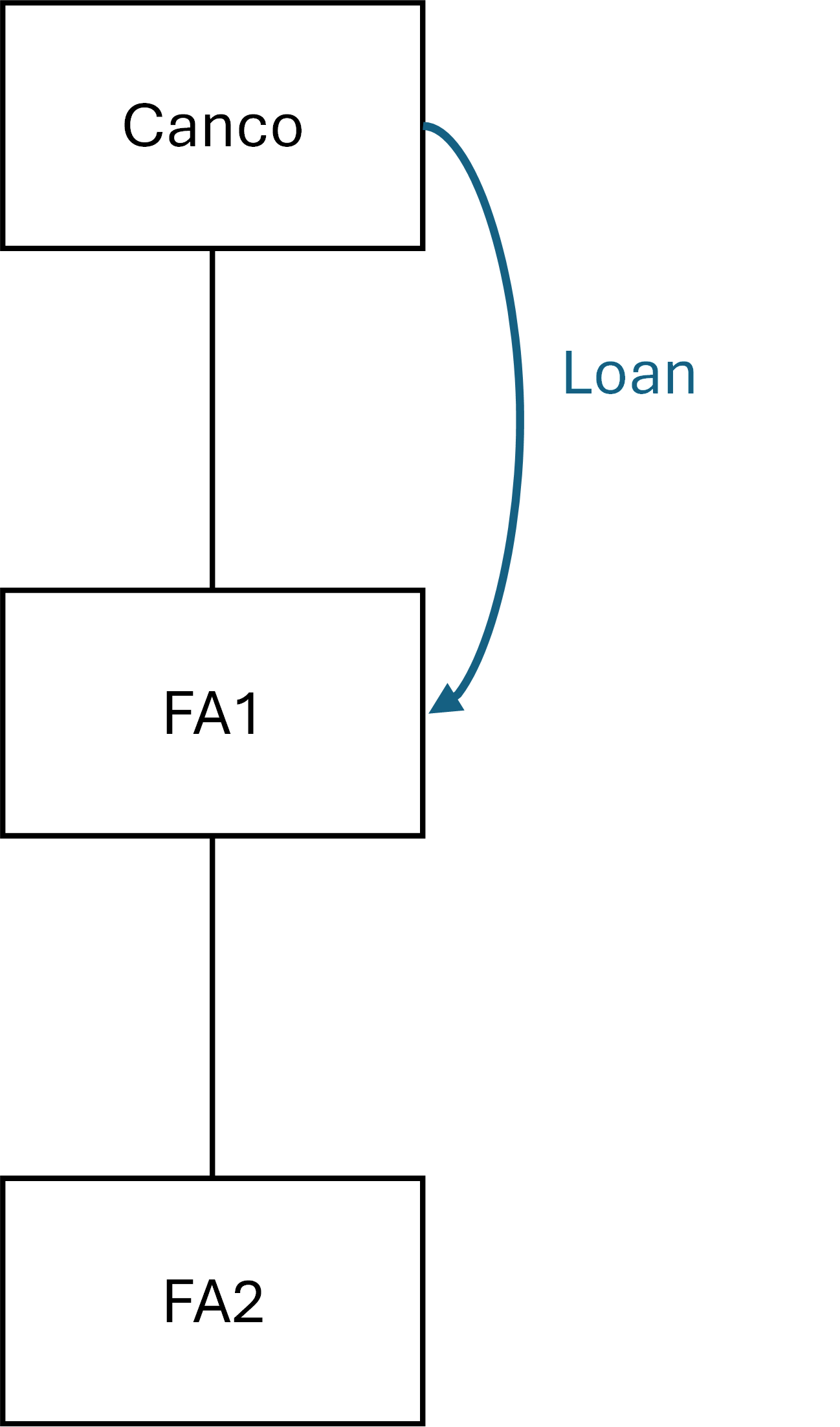
Since FA1 is a shareholder of a particular corporation (FA2), and FA1 has received a loan from a corporation related to FA2 (Canco), in the absence of new subparagraph 15(2.01)(a)(iii), subsection 15(2) would apply to include the amount of the loan in computing the income of FA1 for the year.
However, FA1 is a foreign affiliate of a person resident in Canada with which FA2 does not deal at arm's length (Canco) as described in new subparagraph 15(2.01)(a)(iii). Consequently, subsection 15(2) does not apply to the loan from Canco to FA1.
Example – partnership loan with foreign affiliate member
Relevant facts:
- a CRIC (Canco) wholly owns two foreign corporations (FA1 and FA2);
- FA1 and FA2 are the only members of a foreign partnership (Foreign LP); and
- Canco makes a loan to Foreign LP in the year.
Partnership loan with foreign affiliate member
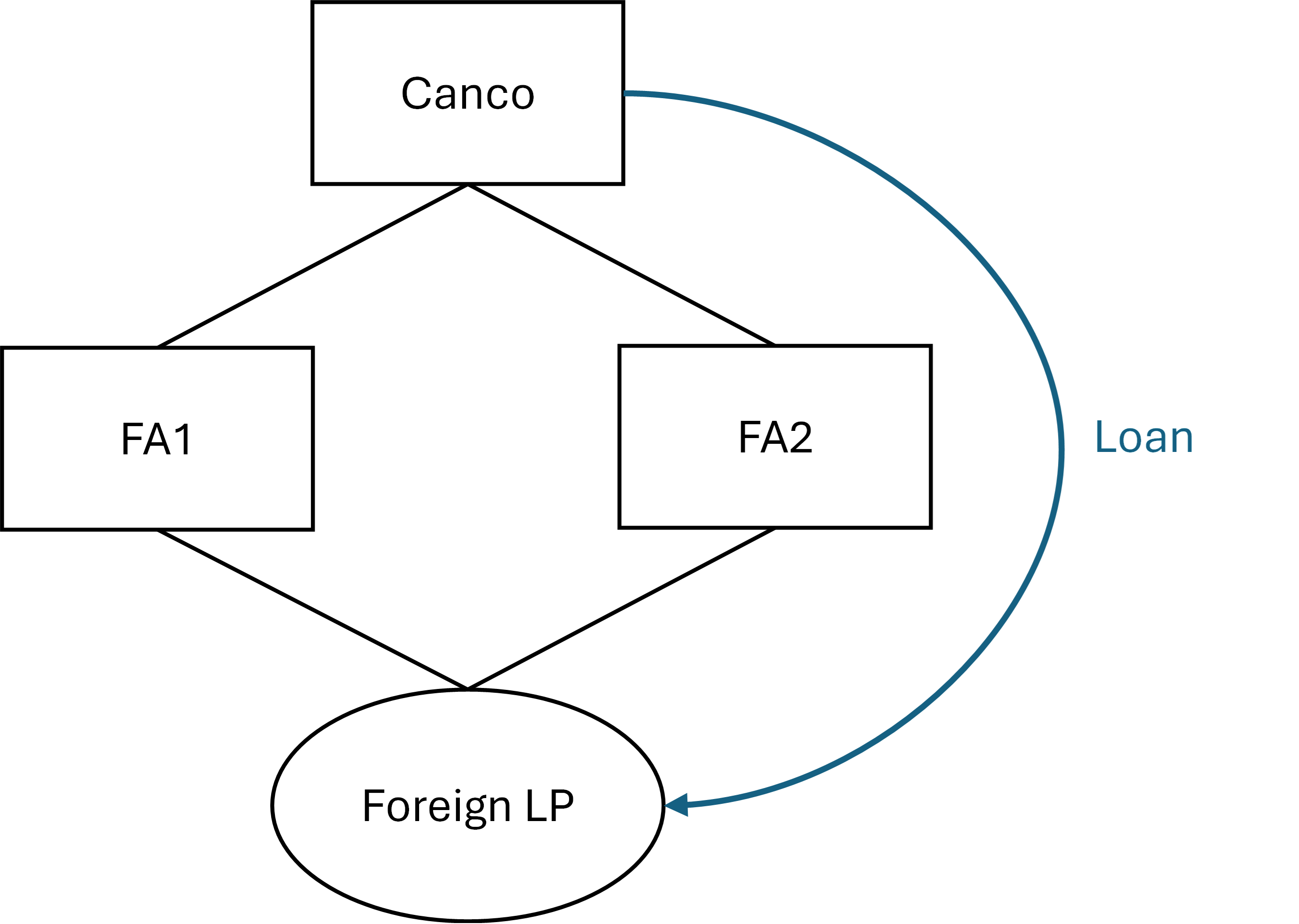
Pursuant to subsection 15(2.1), Foreign LP is connected, in respect of a particular corporation (FA1), with a shareholder of FA1 (Canco) because Foreign LP is affiliated with Canco.
In the absence of new subparagraph 15(2.01)(a)(iii), since Foreign LP is connected with a shareholder of FA1 (Canco), and Foreign LP has received a loan from a corporation related to FA1 (Canco), subsection 15(2) would apply to include the amount of the loan in computing the income of Foreign LP for the year.
However, with new subparagraph 15(2.01)(a)(iii), Foreign LP is a partnership described in paragraph 15(2.01)(b) because each member of the partnership (FA1 and FA2) is a foreign affiliate of a person resident in Canada with which FA1 does not deal at arm's length (Canco). Consequently, subsection 15(2) does not apply to the loan from Canco to Foreign LP.
Similar results would apply if FA2 is the particular corporation.
This amendment applies to loans received and indebtedness incurred after Announcement Date.
Meaning of connected
ITA
15(2.1)
Subsection 15(2) requires that certain indebtedness be included in the income of the debtor in the year in which the indebtedness arose. Paragraphs 15(2)(a) to (c) describe the debtors to which this rule applies in terms of their relationship with a particular corporation. In particular, paragraph 15(2)(b) provides that subsection 15(2) may apply to a debtor that is connected with a shareholder of the particular corporation.
Subsection 15(2.1) specifies that a debtor is connected with the shareholder if the debtor does not deal at arm's length with or is affiliated with the shareholder, unless the debtor is
- a foreign affiliate of the particular corporation, or
- a foreign affiliate of a person resident in Canada with which the particular corporation does not deal at arm's length.
Subsection 15(2.1) is amended to remove its paragraphs (a) and (b) as a consequence to the inclusion of these exceptions and other new exceptions to subsection 15(2) in amended subsection 15(2.01). Consequently, the exception to subsection 15(2) for persons described in paragraphs 15(2.1)(a) and (b) is no longer restricted to the connected test described in subsection 15(2.1). See the commentary to subsection 15(2.01) for more information.
This amendment applies to loans received and indebtedness incurred after Announcement Date.
Clause 5
Definitions
ITA
18.2(1)
"excluded interest"
Paragraph (c) of the definition "excluded interest" is amended to expand the circumstances in which an excluded interest election is available in respect of interest paid or payable to a financial institution group entity. It has also been redrafted in parts for clarity.
As a result of the amendments to paragraph (c), where a payee is a financial institution group entity, an excluded interest election is permitted if the payer either is a financial institution group entity, or would be a "special purpose loss corporation" (as defined in subsection 18.2(1)) if the reference to "financial holding corporation" in that definition were replaced with a reference to "financial institution group entity".
This amendment is intended to facilitate loss utilization transactions that are effectively between financial institution group entities but that rely on the use of a temporary, intermediary special purpose loss corporation. As this loss entity is not itself a financial institution group entity, the excluded interest election would not otherwise be available where the loss entity pays interest to a financial institution group entity.
This amendment applies to taxation years of a taxpayer ending on or after Announcement Date.
"special purpose loss corporation"
The definition "special purpose loss corporation" is amended to clarify that the special purpose loss corporation's loss – the generation of which is the sole purpose for the special purpose loss corporation's existence – must derive from interest paid or payable to a financial holding corporation that is an eligible group entity in respect of the special purpose loss corporation, and must be used exclusively by a financial institution group entity that is an eligible group entity in respect of the special purpose loss corporation.
This amendment applies to taxation years of a taxpayer ending on or after Announcement Date.
Clause 6
Pension benefits, unemployment insurance benefits, etc.
ITA
56(1)(a)(i)
Subparagraph 56(1)(a)(i) includes in the income of a taxpayer for a year certain pension benefits received in the year.
Subparagraph 56(1)(a)(i) is amended by adding clause (H) to clarify that a transfer of unclaimed pension property from a registered pension plan to a designated entity (e.g., the Bank of Canada in the case of federally regulated pension plans) is not included in the income of an individual (i.e., neither the unlocatable former employee nor an unlocatable beneficiary) at the time of that transfer.
Subparagraph 56(1)(a)(i) is further amended by adding clause (C.2) to require that a payment from a designated entity to an eligible claimant must be included in the income of the claimant for the year it is so paid.
This amendment comes into force on royal assent.
Interest free or low interest loans
ITA
56(4.1)(c)
Subsection 56(4.1) applies in certain cases to attribute income from one individual ("the transferee") to another individual ("the transferor") with whom the transferee does not deal at arm's length.
The French version of paragraph 56(4.1)(c) is amended to better align the English and French versions.
Clause 7
Moving expenses of students
ITA
62(2)
Subsection 62(2) provides a deduction for the qualifying moving expenses of an individual who moves to or from Canada to pursue higher education.
The French version of subsection 62(2) is amended to better align the English and French versions.
Clause 8
Change of control
ITA
66.7(10)(j)(ii)(B)
Under subsection 66.7(10), a corporation is treated as a successor for the purposes of the successor rules in section 66.7 after an acquisition of control (or a change in the tax-exempt status) of the corporation.
The French version of clause 66.7(10)(j)(ii)(B) is amended to better align the English and French versions.
Clause 9
Ship of resident corporations - gains
ITA
81(1)(c.2)
Subsection 81(1) of the Act provides that certain amounts are not included in income and therefore are exempt from income tax. Paragraph 81(1)(c) provides a longstanding exemption for non-residents' international shipping income, and paragraph 81(1)(c.1) extends this exemption to certain Canadian-resident corporations.
A capital gain realized by a non-resident from the disposition of a ship used principally in international traffic (or personal or movable property pertaining to the ship's operation) is generally not subject to tax in Canada, because such a ship (or personal or moveable property) is not taxable Canadian property of the non-resident. To improve alignment between the treatment of the gains of non-residents and the gains of residents, new paragraph 81(1)(c.2) is added to exempt from tax the portion of a capital gain earned from the disposition of a ship (or personal or movable property pertaining to the ship's operation) that can reasonably be considered to have accrued while the ship was property of a corporation resident in Canada that can benefit from the exemption in paragraph 81(1)(c.1) and the ship was used by the corporation solely to earn income from international shipping.
This amendment applies to the portion of a taxable capital gain that accrues on or after December 31, 2023.
Clause 10
Public corporation
ITA
87(2)(ii)
Where there has been an amalgamation between two or more predecessor corporations after 1971, to which subsection 87(1) applies, and any of the predecessor corporations was a "public corporation" (as defined in subsection 89(1)) immediately before the amalgamation, paragraph 87(2)(ii) provides that the new corporation is deemed to have been a public corporation at the commencement of its first taxation year.
The definition "public corporation" in subsection 89(1) applies in determining whether a corporation resident in Canada is a public corporation for the purposes of the Act. A corporation is a "public corporation" at a particular time if it satisfies one or more of the criteria outlined in paragraphs (a) to (c) of the definition.
By virtue of paragraph (c) of the definition, once a corporation becomes a public corporation, it continues to be a public corporation if it is resident in Canada unless it complies with the prescribed conditions (subsection 4800(2) of the Income Tax Regulations) and either the corporation elects in a prescribed manner not to be a public corporation or the Minister designates the corporation not to be a public corporation.
However, even where the corporation complies with the prescribed conditions and an election or designation is made not to be a public corporation, it might still be a public corporation if a class of shares of the corporation is listed on a designated stock exchange (as defined in subsection 248(1)) in Canada by virtue of paragraph (a) of the definition. This result is problematic for certain acquisitions of publicly listed corporations since delays in the delisting process on certain stock exchanges can uphold the acquired corporation's status as a public corporation. If the acquired corporation is amalgamated with a private corporation, paragraph 87(2)(ii) will deem the new amalgamated corporation to be a public corporation.
To address this concern, paragraph 87(2)(ii) is amended by introducing an exception to the deeming rule that applies if:
- after the last time a class of shares of the predecessor corporation (that was a public corporation) became listed on a designated stock exchange in Canada and before the amalgamation, an election or designation was made in respect of the corporation under paragraph (c) of the "public corporation" definition;
- immediately before the amalgamation, the predecessor corporation was a subsidiary wholly-owned corporation (as defined in subsection 248(1)) of another corporation (other than a public corporation) (the "Parent"); and
- the amalgamation was a vertical amalgamation between the Parent and the predecessor corporation.
If these conditions are satisfied, the new corporation formed on the amalgamation will not be deemed to be a public corporation by virtue of paragraph 87(2)(ii).
This amendment is deemed to come into force on royal assent.
Clause 11
Definitions for this Subdivision
ITA
95(1)
The definition "foreign accrual property income" (FAPI) in subsection 95(1) of the Act is relevant for the purpose of determining amounts that a taxpayer is to include under subsection 91(1), as income from a share of a controlled foreign affiliate, in computing its income for a particular taxation year. It is also relevant for the purposes of determining the taxable surpluses and deficits of a foreign affiliate of a taxpayer. Variables A to C of the formula in the FAPI definition contain the additions to FAPI and variables D to H contain the deductions from FAPI.
Paragraph (b) of the description of A in the definition generally excludes from the FAPI of a foreign affiliate of a taxpayer dividends received from another foreign affiliate of the taxpayer. However, where a foreign affiliate receives an inter-affiliate dividend that is deductible for foreign tax purposes, the dividend is included in the recipient affiliate's FAPI, consistent with Recommendation 2.1 of the report under Action 2 of the Group of 20 and Organisation for Economic Co-operation and Development's Base Erosion and Profit Shifting Project (the "BEPS Action 2 report"), titled Final Report on Neutralising the Effects of Hybrid Mismatch Arrangements.
Paragraph (b) of the description of A in the FAPI definition is amended to no longer apply the deductible dividend test under subsection 113(5). Instead, the amended paragraph (b) applies a test using the various rules and definitions used for applying subsection 12.7(3), the secondary operative rule of the hybrid mismatch rules.
The amended paragraph (b) excludes inter-affiliate dividends from FAPI in two circumstances. The first exclusion is provided in subparagraph (i), which excludes from FAPI any dividends received from another affiliate where the recipient affiliate and the payor affiliate are resident in the same country. This exclusion applies regardless of whether the dividend is deductible for foreign tax purposes, so long as the residency test is met.
The second exclusion, which is in subparagraph (ii), applies to the extent a dividend does not result in a "deduction/non-inclusion mismatch" (as determined under paragraph 18.4(7)(c)). It limits the FAPI inclusion to circumstances where a dividend is deductible for foreign tax purposes but is not included in computing foreign relevant income or profits. If all or any portion of the amount of the dividend was deductible by the payor affiliate but not included in computing the "foreign ordinary income" (as defined in subsection 18.4(1)) of the recipient affiliate, there is an inclusion in the FAPI of the recipient affiliate to the extent of the amount of the deduction/non-inclusion mismatch. For this purpose, clauses (b)(ii)(A) and (B) set out two modifications in applying the deduction/non-inclusion mismatch test under subsection 18.4(6). First, that test is limited exclusively to the test in paragraph (b) of that subsection and thus ignores any inclusion of the dividend in "Canadian ordinary income". Absent this modification, there is a potential circularity as sub-clause 95(2)(f.11)(ii)(F)(IV) modifies the "Canadian ordinary income" definition to read in paragraph (b) of the FAPI definition. The second modification is made to the description of C in the definition "foreign ordinary income", to ensure that an inclusion in foreign ordinary income as a result of a "foreign hybrid mismatch rule" (as defined in subsection 18.4(1)) is taken into consideration in determining whether there is a deduction/non-inclusion mismatch.
Variable H in the FAPI definition is relevant where a foreign affiliate of a taxpayer is a member of a partnership that receives a dividend from another foreign affiliate of the taxpayer. It ensures that the dividend is not included in the member's FAPI. Variable H is amended to implement the same policy, and achieve a similar result, as the amendment to paragraph (b) of the description of A (described above).
These amendments apply in respect of dividends received on or after July 1, 2024.
Clause 12
Reference to trust or estate
ITA
104(1)
Subsection 104(1) provides a rule under which a reference to a trust or estate is read in the Act as a reference to the trustee or the executor, administrator, heir or other legal representative having ownership or control over trust property.
Subsection 104(1) currently provides that, except for the purposes of certain specified provisions, references in the Act to trusts are considered not to include an arrangement where a trust can reasonably be considered to act as agent for its beneficiaries with respect to all dealings in all of the trust's property. These arrangements are generally known as "bare trusts". Trusts described in paragraphs (a) to (e.1) of the definition "trust" in subsection 108(1) are expressly not affected by this exclusion. Subsection 104(1) currently provides that the exclusion for bare trusts does not apply for the purposes of section 150. As such, these trusts are generally required to file an annual trust return and are subject to the beneficial ownership reporting requirements set out in section 204.2 of the Income Tax Regulations.
Subsection 150(1.3) also provides that for the purpose of section 150 a trust includes an arrangement under which a trust can reasonably be considered to act as agent for all the beneficiaries under the trust with respect to all dealings with all of the trust's property.
Subsection 150(1.3) is being amended to more clearly define the beneficial ownership arrangements that are subject to the reporting rules. This subsection will, subject to the exceptions in subsection 150(1.31), deem certain beneficial ownership arrangements that would not otherwise constitute a trust for the purposes of the Act to be a trust for the purposes of the beneficial ownership reporting rules.
Subsection 104(1) is amended to remove the reference to section 150. As such, beneficial ownership arrangements that are not otherwise treated as trusts for the purposes of the Act will only be subject to the beneficial ownership reporting requirements if they are deemed to be trusts under new subsection 150(1.3). This amendment will apply for taxation years that end after December 30, 2024.
Clause 13
Application of paragraph (1)(a)
ITA
107.4(2)(b)
Paragraph 107.4(2)(b) deems there to be no change in beneficial ownership of a property where the property is transferred from a trust governed by an RRSP or RRIF to another trust governed by an RRSP or RRIF, provided that the annuitant of the transferor is the same as that of the transferee.
Since property may be transferred from an RRSP to an FHSA of an individual (see paragraph 146(16)(a.2)), or from an individual's FHSA to an RRSP or RRIF under which the individual is the annuitant (see subsection 146.6(7)), or between FHSAs of the same individual, paragraph 107.4(2)(b) is amended to refer to trusts governed by an FHSA.
This amendment comes into force on April 1, 2023.
Clause 14
Employee options
ITA
110(1)(d)(i)(B)
Paragraph 110(1)(d) provides for a deduction in computing taxable income if certain conditions are met. The deduction is currently equal to half (proposed to be changed to one third consequential on proposed changes to the capital gains inclusion rate) of the amount of the benefit deemed by subsection 7(1) to have been received by a taxpayer in respect of a security under an employee stock option agreement.
Paragraph 110(1)(d) permits a deduction in computing taxable income of a deceased taxpayer who is deemed by subsection 7(1)(e) to have received a benefit in respect of a security because, immediately before death, the taxpayer owned a right to acquire the security under an employee stock option agreement. Under clause 110(1)(d)(i)(B), the deduction is available in these circumstances if (among other conditions) the security is acquired under the agreement within the first taxation year of the graduated rate estate of the taxpayer by:
- the graduated rate estate of the taxpayer,
- a person who is a beneficiary (as defined in subsection 108(1)) under the graduated rate estate of the taxpayer, or
- a person in whom the rights of the taxpayer under the agreement have vested as a result of the taxpayer's death.
Clause 110(1)(d)(i)(B) is amended consequential to changes to subsection 164(6.1) which provides the graduated rate estate of a deceased individual an additional two taxation years to carry back certain amounts related to rights to acquire securities held by the individual immediately before their death (as determined under subsection 164(6.1)) to be deducted in computing the deceased individual's income for their last taxation year.
For more information, see the commentary on subsection 164(6.1).
This amendment applies to taxation years of individuals who die on or after Announcement Date.
Annual vesting limit
ITA
110(1.31)
Subsection 110(1.31) applies to securities sold or issued by a qualifying person under a stock option agreement if the conditions in subsection 110(1.3) are met in respect of that agreement. It provides a formula for calculating the proportion of securities that are deemed to be non-qualified securities.
Subsection 110(1.31) is amended in two ways. First, the preamble is amended to clarify that the annual vesting limit formula, which deems a proportion of securities to be sold or issued under an agreement to be non-qualified securities, applies only in respect of those securities that could give rise to a deduction under paragraph 110(1)(d) (such securities being referred to as "specified securities" throughout the subsection). Other compensation arrangements that would not give rise to a paragraph 110(1)(d) deduction are not intended to count against the annual vesting limit.
Paragraph (b) under Variable D is amended to remove subparagraph (i), referring to securities that have been designated under subsection 110(1.4) as non-qualified securities (such securities cannot give rise to a deduction under paragraph 110(1)(d)). Similarly, clause (B) is removed. Narrowing the application of subsection (1.31) to only specified securities renders these two exclusions from paragraph (b) irrelevant.
Example
For example, assume Nathalie has entered into two equity-based compensation arrangements with her employer sequentially. The first agreement issues $400,000 worth of employee stock options (referring to the value of the underlying securities) and $250,000 worth of restricted share awards (meaning a right to acquire shares, on future vesting of the award, for a nil or nominal strike price). The second agreement issues $300,000 worth of employee stock options (referring to the value of the underlying securities) and $250,000 worth of restricted share awards. To demonstrate the effect of the amendment, assume all vest in the employee in the same year.
The table below illustrates how the formula in subsection 110(1.31) works pre- and post-amendment.
| Pre-Amendment | ||
|---|---|---|
| s. 110(1.31) | Agreement #1 | Agreement #2 |
| A | C + D - $200,000 = $450,000 | C + D - $200,000 = $450,000 |
| B | $650,000 | $450,000 |
| C | $650,000 | $450,000 |
| D | $0 | $200,000 |
| Result (A ÷ B) | $450,000/$650,000 = 69% of agreement #1 securities deemed non-qualified | $450,000/$450,000 = 100% of agreement #2 securities deemed non-qualified |
| Post-Amendment | ||
| s. 110(1.31) | Agreement #1 | Agreement #2 |
| A | C + D - $200,000 = $200,000 | C + D - $200,000 = $300,000 |
| B | $400,000 | $300,000 |
| C | $400,000 | $300,000 |
| D | $0 | $200,000 |
| Result (A ÷ B) | $200,000/$400,000 = 50% of agreement #1 securities deemed non-qualified | $300,000/$300,000 = 100% of agreement #2 securities deemed non-qualified |
In the absence of the amendment, the formula unintentionally counts Nathalie's restricted share awards against her annual vesting limit. The amendment ensures that the intended outcome, i.e., that $200,000 worth of stock options vesting in the same year are qualified (and therefore eligible for the employee stock option deduction), and that the remaining $500,000 worth of stock options are deemed non-qualified.
This amendment applies to agreements to sell or issue securities entered into after June 2021. However, it does not apply in respect of rights under an agreement to which subsection 7(1.4) of the Act applies that are new options in respect of which an exchanged option was issued before July 2021. This application date is retroactive to when the limitation in subsection 110(1.31) first began to apply.
Clause 15
Definitions
ITA
110.6(1)
"qualified small business corporation share"
This definition is relevant for the purposes of the capital gains exemption as only shares that constitute qualified small business corporation shares can qualify for the exemption.
The French version of paragraph (d) of the definition is amended to better align the English and French versions.
Clause 16
Loss on share held by trust
ITA
112(3.2)(a)(iii)
Subsection 112(3.2) provides a "stop-loss" rule that applies to reduce the loss of a trust (other than a mutual fund trust) on the disposition of a share of the capital stock of a corporation that was held by the trust as capital property.
Paragraph 112(3.2)(a) provides that the trust's loss otherwise determined on the disposition of the share is reduced by certain dividends received by the trust on the share. However, subparagraph 112(3.2)(a)(iii) limits this reduction in the case where the trust is an individual's graduated rate estate, the share was acquired as a consequence of the individual's death and the disposition occurs in the first taxation year of the estate. In this case, the loss reduction is reduced by half (proposed to be changed to one third consequential on proposed changes to the capital gains inclusion rate) of the lesser of the loss otherwise determined and the individual's capital gain from the disposition of the share immediately before the individual's death.
Subparagraph 112(3.2)(a)(iii) is amended consequential to changes to paragraph 164(6) which provide the graduated rate estate of a deceased individual an additional two taxation years to elect to treat certain capital losses and terminal losses of the taxpayer's estate as losses of the taxpayer for the taxpayer's last taxation year.
For more information, see the commentary on subsection 164(6).
This amendment applies to taxation years of graduated rate estates of individuals who die on or after Announcement Date.
Clause 17
Non-resident persons — 2010 Olympic and Paralympic Winter Games
ITA
115(2.3)
Subsection 115(2.3) exempts from taxable income amounts paid to certain non-resident persons in respect of activities performed in connection with the 2010 Olympic Winter Games or the 2010 Paralympic Winter Games.
As this provision is no longer relevant, it is repealed.
Clause 18
Annual adjustment
ITA
117.1(1)
Subsection 117.1(1) provides for the indexing of various amounts in the Act, based on annual increases to the Consumer Price Index.
The French version of subsection 117.1(1) is amended to better align the English and French versions.
Clause 19
Definitions
ITA
118(7)
"pension income"
Subparagraph (a)(iii.1) of the definition "revenu de pension" in the French version of the Act is amended to better align the French and the English versions of these subparagraphs. More specifically, a reference to "périodique" is deleted from the French version.
Clause 20
Definitions
ITA
120.4(1)
"excluded amount"
The definition "excluded amount" in subsection 120.4(1) describes income that is excluded from split income of an individual.
Paragraph (a) excludes from split income amounts derived from property that is inherited by an individual who has not attained the age of 24 years before the year from a parent, or from any other person if certain additional conditions are met.
Paragraph (b) excludes from split income amounts derived from property that is acquired by an individual under a transfer described in subsection 160(4). As a result, where a taxpayer transfers property to the taxpayer's spouse or common-law partner pursuant to a decree, order or judgment of a competent tribunal or a written separation agreement and, at that time, the taxpayer and spouse or common law partner were separated and living apart as a result of the breakdown of their marriage or common-law partnership, the income derived by the spouse or common-law partner from the property will be an excluded amount in respect of the spouse or common-law partner.
Paragraphs (a) and (b) are amended to ensure that an amount of income or taxable capital gain or profit, as the case may be, continues to qualify as an "excluded amount" where a property described in paragraph (a) or (b) is substituted for another property.
This amendment comes into force on Announcement Date.
Clause 21
Training amount limit
ITA
122.91(2)(a)(i)
Subsection 122.91(2) provides for the calculation of an individual's "training amount limit" for a taxation year for the purposes of the Canada Training Credit in subsection (1).
Subparagraph (a)(i) provides that an individual's training amount limit increases every year by $250, provided certain conditions are met, including that the total of certain specified amounts be equal to or exceed $10,000 in respect of the preceding taxation year. These specified amounts include certain amounts payable to the individual under the Employment Insurance Act.
Consequential to the enactment of new subsections 22.1(1) and 152.041(1) of the Employment Insurance Act relating to a new adoption benefit, subparagraph (a)(i) is amended to include references to these new provisions in sub-subclause (A)(III)2 of the description of B, applicable on the same date that these new provisions come into force.
Clause 22
Former resident — reassessment period
ITA
126(2.211)
Subsection 126(2.21) provides limited credits against an individual's Canadian tax that arises in the year of the individual's departure from Canada, for post-departure foreign taxes.
New subsection 126(2.211) provides that the Minister may make any assessment, reassessment or additional assessment in respect of the year of the individual's departure from Canada to take into account a deduction under subsection (2.21). This new subsection will ensure that the Minister may take into account this deduction where the period of time between the individual's departure from Canada and the moment when the foreign taxes arise is such that the Minister would otherwise have been prevented from doing so because of subparagraph 152(4)(b)(i).
Clause 23
Deemed rebate in respect of fuel charges
ITA
127.42(10)
New subsection 127.42(10) confirms that amounts paid under this section are deemed to have been paid as rebates in respect of charges levied under Part 1 of the Greenhouse Gas Pollution Pricing Act.
Clause 24
Adjusted taxable income determined
ITA
127.52(1)(d.1)
Paragraph 38(a.1) provides that the taxable capital gains inclusion rate is 0% on the donation of publicly listed securities to qualified donees. Paragraph 125.52(1)(d.1) provides that the taxable capital gains inclusion rate on the donation of publicly listed securities will be 3/10 (or 30%) for the purposes of computing an individual's minimum tax.
Paragraph 125.52(1)(d.1) is amended to provide that this paragraph would not apply to donations of a flow-through class of property (as defined in section 54). As such, donations of a flow-through class of property would not be subject to the AMT. Donations of a flow-through share class of property are addressed in new paragraph 127.52(1)(d.2).
This amendment applies to taxation years that begin after 2023.
ITA
127.52(1)(d.2)
This amendment adds new paragraph 127.52(1)(d.2). This amendment provides that the taxable capital gains inclusion rate on the donation of publicly listed securities will be 3/10 (or 30%) for the purposes of computing an individual's minimum tax of the capital gain that is the "true" capital gain from the disposition of a flow-through share class of property.
This amendment applies to taxation years that begin after 2023.
ITA
127.52(1)(e) and (e.1)
Paragraph 127.52(1)(e) provides that "adjusted taxable income" is computed on the assumption that the total of specified resource-related deductions does not exceed specified resource income. Paragraph 127.52(1)(e.1) provides that "adjusted taxable income" is computed on the assumption that financing expenses deductible under paragraphs 20(1)(c) to (f) in respect of the acquisition of flow-through shares, Canadian resource properties or foreign resource properties do not exceed the amount by which the same specified resource income exceeds the same specified resource-related deductions.
These paragraphs are repealed.
This amendment applies to taxation years that begin after 2023.
ITA
127.52(1)(j)
Paragraph 152(1)(j) limits certain deductions to a rate of 50% for the purposes of computing an individual's minimum tax.
Subparagraph 125.52(1)(j)(ii) provides that for the purposes of computing an individual's minimum tax, the individual may only deduct one half of the amounts otherwise deducted in the year for interest and financing expenses in respect of an amount borrowed to earn income from property. This limitation does not apply for the purposes of other provisions of the minimum tax rules that apply to limit the deduction of interest and financing expenses for specific purposes. The limitation also does not apply to money borrowed by an employee ownership trust (or a Canadian-controlled private corporation that is controlled and wholly-owned by the trust) to acquire a qualifying business pursuant to a qualifying business transfer.
Paragraph 127.52(1)(j)(ii) is amended to provide that this 50% limitation on the deduction of expenses also applies to amounts deducted under paragraph 20(1)(bb) (fees paid to investment counsel).
This amendment applies to taxation years that begin after 2023.
Clause 25
Post-emigration loss — reassessment period
ITA
128.1(8.1)
Subsection 128.1(8) provides relief to an individual (other than a trust) who disposes of a taxable Canadian property, after having emigrated from Canada, for proceeds that are less than the deemed proceeds that arose under paragraph 128.1(4)(b) in respect of the property when the individual emigrated. Under subsection 128.1(8) the individual may elect to reduce the proceeds of disposition that were deemed to arise under paragraph 128.1(4)(b) in respect of a property by the least of certain specified amounts.
New subsection 128.1(8.1) provides that the Minister may make any assessment, reassessment or additional assessment in respect of the year in which the proceeds of disposition were deemed to arise to take into account an election to reduce those proceeds under subsection (8). This new subsection will ensure that the Minister may take into account the election where the period of time between the moment when the proceeds of disposition were deemed to arise and the moment when the property is subsequently disposed of is such that the Minister would otherwise have been prevented from doing so because of subparagraph 152(4)(b)(i).
Clause 26
Acceptance of plan for registration
ITA
146(2)
Subsection 146(2) of the Act sets out the conditions that a registered retirement savings plan must comply with in order to be registered with the Canada Revenue Agency.
That subsection is amended to add a requirement that an application for registration be made in a prescribed manner. See additional commentary for the amendment to the definition "prescribed" in subsection 248(1) of the Act.
This amendment comes into force on royal assent.
Transfer of funds
ITA
146(16)(b)
Subsection 146(16) allows taxpayers to transfer funds on a tax-deferred basis from their registered retirement savings plan (RRSP) to registered vehicles listed in that subsection before maturity of the transferor RRSP.
Paragraph 146(16)(b) is amended to allow for a transfer from an RRSP to a registered pension plan for the benefit of a spouse or common-law partner or former spouse or common-law partner as a result of a division of property on the breakdown of marriage or common-law partnership. In addition, the requirement for "living separate and apart" is deleted.
This amendment comes into force on royal assent.
Clause 27
Acceptance of fund for registration
ITA
146.3(2)
Subsection 146.3(2) of the Act sets out the conditions that a registered retirement income fund must comply with in order to be registered with the Canada Revenue Agency.
That subsection is amended to add a requirement that an application for registration be made in a prescribed manner. See additional commentary for the amendment to the definition "prescribed" in subsection 248(1) of the Act.
This amendment comes into force on royal assent.
Transfer on breakdown of marriage or common-law partnership
ITA
146.3(14)
Subsection 146.3(14) provides for the direct transfer (i.e., tax deferred) of an amount from an annuitant's RRIF to an RRSP or RRIF of the annuitant's current or former spouse or common-law partner on the breakdown of their marriage or common-law partnership.
Paragraph 146.3(14)(b) is amended by adding a subparagraph (ii) to include registered pension plans in the list of vehicles available for a direct transfer from a RRIF for the benefit of the annuitant's current or former spouse or common-law partner after the relationship breakdown.
This amendment comes into force on royal assent.
Clause 28
Definitions
ITA
146.5(1)
"advanced life deferred annuity"
The definition "advanced life deferred annuity" (ALDA) in subsection 146.5(1) of the Act provides the conditions that an annuity contract must meet to qualify as an ALDA contract.
Amendments to subsections 146.5(1), (4.1) and (5) of the Act are being made to better align the ALDA tax rules with various provincial pension standards laws that apply to annuities purchased from registered plans.
Subparagraph 146.5(1)(c)(ii) is amended to add a reference to a former spouse or common-law partner of the annuitant to allow for the annuity to be payable for the joint life of the annuitant and their former spouse or partner, consistent with provincial legislation.
Subparagraph 146.5(1)(d)(ii) is amended to allow the amount of the annuity to be changed to allow sharing of rights between spouses or common-law partners after the breakdown of a marriage or a partnership. It is also amended to allow for an annuity to be adjusted on an actuarially equivalent basis if a spouse or common-law partner is no longer entitled to the annuity.
Paragraph (f) of the definition describes the sole type of lump sum death benefit payable from an ALDA. Subparagraph (f)(ii) is amended to allow the death benefit to be computed with interest at a rate specified under pension benefit standards legislation.
New paragraph (g.1) is added to the definition to allow for the payment under the contract to a spouse or common-law partner (or former spouse or common-law partner) on or after the breakdown of their marriage or common-law partnership in settlement of rights from their marriage or partnership as a single amount, periodic payment or a direct transfer to an RRSP, RRIF, pooled registered pension plan or a money purchase provision of a registered pension plan.
Paragraph (i) of the definition requires the annuity contract to stipulate that no right under the contract is capable of being assigned, charged, anticipated, given as security or surrendered. Paragraph (i) is amended to provide an exception for amounts required to be paid as a result of the breakdown of marriage as described in new paragraph (g.1) or support payments made under a judicial order or a written agreement.
These amendments are deemed to come into force on January 1, 2023.
Taxable amount – marriage breakdown
ITA
146.5(4.1)
New subsection 146.5(4.1) is added to the Act to require that amounts paid under paragraph (g.1) of the definition of "advanced life deferred annuity" (in subsection 146.5(1)) be included in the income of the recipient spouse or common-law partner (or former spouse or common-law partner), unless subsection 146.5(5) applies.
This amendment is deemed to come into force on January 1, 2023.
Treatment of amount transferred
ITA
146.5(5)
Subsection 146.5(5) of the Act contains rules that apply to an amount refunded from an ALDA that is transferred directly to a registered vehicle.
Subsection 146.5(5) is amended, consequential to paragraph (g.1) of the definition of "advanced life deferred annuity" (in subsection 146.5(1)), so that these rules will also apply to the transfers described in subparagraph (g.1)(ii)(C).
This amendment is deemed to come into force on January 1, 2023.
Clause 29
Definitions
ITA
146.6(1)
"annual FHSA limit"
The definition "annual FHSA limit" is used in the determination of the amount an individual may deduct under subsection 146.6(5), in respect of contributions to a FHSA, in computing the individual's income for a particular taxation year. The annual FHSA limit for a particular taxation year is the lesser of paragraphs (a), (b) and (c) of the definition.
The definition is amended to ensure that designated withdrawals made after a qualifying withdrawal do not unintentionally result in disallowance of deductions for contributions made prior to the qualifying withdrawal. In particular, variable C in paragraph (a) of the definition is amended to exclude amounts designated after the taxpayer's first qualifying withdrawal from the total of all designated amounts described in paragraph (b) of the definition designated amount in subsection 207.01(1) for the year.
This amendment comes into force on April 1, 2023.
Deemed transfer or distribution
ITA
146.6(15)
Subsection 146.6(15) of the Act deals with situations in which an amount paid from a deceased holder's FHSA to the holder's estate would have been eligible for a tax-free transfer under subsection 146.6(7) to a survivor (spouse or common-law partner), or would have been taxable to a beneficiary if the amount had been paid directly to the beneficiary from the FHSA, to the extent that the recipient has a beneficial interest under the deceased holder's estate.
Paragraph 146.6(15)(a) allows the legal representative of a deceased holder's estate and the survivor to jointly designate (via a prescribed form) to have the FHSA proceeds that were paid to the estate treated as having been transferred from the FHSA of the deceased holder to an FHSA, RRSP or RRIF of the survivor.
In the same vein as the recently amended subsection 146(8.1), this amendment will permit a joint designation to be filed in cases where a spouse or common-law partner is neither a successor holder nor a beneficiary of the FHSA or the estate of the deceased FHSA holder, but where a payment is made from the estate to a surviving spouse or common-law partner in accordance with a court order or written agreement relating to rights or interests in respect of the property from a marriage or common-law partnership. Furthermore, the words "in full or partial satisfaction of the survivor's rights" are removed, as they are unnecessary for the interpretation and application of the provision.
This amendment comes into force on April 1, 2023.
Clause 30
Definitions
ITA
147(1)
"deferred profit sharing plan"
Subsection 147(1) defines terms used in the provisions relating to deferred profit sharing plans (DPSPs).
The definition of "deferred profit sharing plan" is amended to remove the requirement that both the trustee under the plan and an employer of employees who are beneficiaries under the plan apply in prescribed manner for registration. The new requirement is that either the trustee under the plan or a participating employer may apply in prescribed manner for registration.
This amendment comes into force on royal assent.
Clause 31
Notice of revocation
ITA
147.1(12)
Subsection 147.1(12) provides that, after the Minister of National Revenue has given a notice of intention to revoke the registration of a pension plan, the Minister may give a further notice that the registration of the plan is revoked as of a specified date, which date may be no earlier than the date stated in the notice of intent. Subsection 147.1(12) also allows the Minister to give a notice of revocation where a plan administrator applies for the revocation of plan registration.
Subsection 147.1(12) is amended to clarify that the date of revocation in an administrator's application to revoke a plan's registration only applies in the case where the Minister of National Revenue has not given a notice of intention to revoke. That is, if the Minister had issued a notice of intention, the date of revocation specified by the Minister will prevail over any other date requested by the plan administrator.
This amendment comes into force on royal assent.
Clause 32
Commutation of annuity contract
ITA
147.4(4) and (5)
Where an individual acquires ownership of an annuity in satisfaction of the individual's entitlement to benefits under a registered pension plan (RPP) and certain other conditions are met, subsection 147.4(1) deems the individual not to have received an amount from the RPP as a result of acquiring the annuity and deems amounts received under the contract to be amounts received under the RPP. As a consequence, there is no immediate taxation on acquisition of the annuity and any payments under the contract are included in the recipient's income in the year in which they are received.
The Act currently prohibits the value of the annuity from being transferred to a registered vehicle of the annuitant. Section 147.4 is amended by adding subsections (4) and (5) to allow for a transfer of the commuted value of the annuity in certain circumstances.
Subsection 147.4(4) sets out the situations in which an annuity contract may be commuted and transferred on a tax-deferred basis, including if
- a spouse or common-law partner or former spouse or common-law partner is entitled to a portion of the annuity in settlement of rights on the breakdown of marriage or common-law partnership,
- in the case of an annuity that had been purchased on behalf of an individual consequential to proceedings commenced under the Bankruptcy and Insolvency Act or the Companies' Creditors Arrangement Act, the individual subsequently decides, before annuity payments commence, to surrender the annuity and receive its commuted value,or
- the Pension Benefits Standards Act, or similar law of a province permits the annuitant to commute or surrender the annuity.
Subsection 147.4(5) sets out the registered vehicles where the commuted value may be transferred, if the conditions in new subsection 147.4(4) are met. The commuted value may be transferred to a money purchase provision of an RPP, registered retirement savings plan or registered retirement income fund of the annuitant (or the spouse or common-law partner or former spouse or common-law partner of the annuitant).
In the case of an interest in the annuity contract that was acquired as a consequence of a transfer of property from a defined benefit provision of a pension plan, the amount transferred may not exceed the prescribed amount described in paragraph 147.3(4)(c) to be transferred to a money purchase provision of a registered pension plan, registered retirement savings plan or registered retirement income fund.
This amendment comes into force on January 1, 2018.
Clause 33
Exclusions
ITA
149.1(1.1)
Subsection 149.1(1.1) of the Act excludes certain amounts from being included in determining if a registered charity has satisfied its annual disbursement quota.
Existing paragraph 149.1(1.1)(d) provides that expenditures on administration and management of the charity shall not be considered to have been expended on charitable activities carried on by the organization for the purposes of satisfying its disbursement quota.
Paragraph 149.1(1.1)(d) is amended to add a reference to fundraising. This clarifies that expenditures on fundraising do not count towards satisfying an organization's disbursement quote.
Whether a particular expenditure relates to administration, management and fundraising will be a factual determination based on the activities and practices of the organization.
This amendment comes into force on royal assent.
Clause 34
Exception
ITA
150(1.1)(a)
Subsection 150(1) stipulates the tax return requirements and the filing dates for different categories of taxpayers. Subsection 150(1.1) sets out exceptions to subsection 150(1), when the filing of a tax return is not required.
Currently, paragraph 150(1.1)(a) only exempts a registered charity from the filing requirements under subsection 150(1) if it is also a corporation.
Paragraph 150(1.1)(a) is amended to exempt from the filing requirements under subsection 150(1) any taxpayer who was a registered charity throughout the year.
Exception - trusts
ITA
150(1.2)(b)
Subsection 150(1) stipulates the tax return requirements and the filing dates for different categories of taxpayers. Subsection 150(1.1) sets out exceptions to subsection 150(1), when the filing of a tax return is not required. Subsection 150(1.2) provides that subsection 150(1.1) does not apply in respect of an express trust, unless it meets one of the exceptions listed in paragraphs 150(1.2)(a) to (p).
In addition, a trust that is required to file a return under subsection 150(1) is not required to provide the additional information set out in section 204.2 of the Regulations if it meets one of the exceptions listed in paragraphs 150(1.2)(a) to (p). As such, trusts that are required to file a return, and that do not meet one of these exceptions, will be required to provide the additional information outlined in section 204.2 of the Regulations.
Several amendments are being made to add or broaden exceptions in subsection 150(1.2).
Paragraph 150(1.2)(b) provides that the beneficial ownership reporting requirement does not apply in respect of a trust if the trust hold assets with a total fair market value that does not exceed $50,000 throughout the year, where the only assets held by the trust throughout the year are one or more of:
- money,
- certain government debt obligations,
- a share, debt obligation or right listed on a designated stock exchange,
- a share of the capital stock of a mutual fund corporation,
- a unit of a mutual fund trust,
- an interest in a related segregated fund (within the meaning assigned by paragraph 138.1(1)(a), and
- an interest, as a beneficiary under a trust, that is listed on a designated stock exchange.
Paragraph 150(1.2)(b) is amended to remove the requirement that the assets of the trust constitute the specific assets currently prescribed in that paragraph.
New paragraph 150(1.2)(b.1) provides an expanded relieving exception where each beneficiary of the trust is an individual and related to each trustee of the trust. This new exception would apply where:
- each trustee is an individual, and
- the total fair market value of the property of the trust does not exceed $250,000 throughout the year and the only assets held by the trust throughout the year are one or more of
- money,
- a guaranteed investment certificate issued by a Canadian bank or trust company incorporated under the laws of Canada or of a province,
- a debt obligation described in paragraph (a) of the definition fully exempt interest in subsection 212(3),
- debt obligations issued by
- a corporation, mutual fund trust or limited partnership the shares or units of which are listed on a designated stock exchange in Canada,
- a corporation the shares of which are listed on a designated stock exchange outside Canada, or
- an authorized foreign bank that are payable at a branch in Canada of the bank,
- a share, debt obligation or right listed on a designated stock exchange,
- a share of the capital stock of a mutual fund corporation,
- a unit of a mutual fund trust,
- an interest in a related segregated fund trust (within the meaning assigned by paragraph 138.1(1)(a)),
- an interest as a beneficiary under a trust, all the units of which are listed on a designated stock exchange,
- personal use property of the trust, or
- a right to receive income on property described above.
Paragraph 150(1.2)(c) provides an exemption to the beneficial ownership reporting requirements for trusts that are required under the relevant rules of professional conduct or the laws of Canada or a province to hold funds for the purposes of the activity that is regulated under those rules or laws, provided the trust is not maintained as a separate trust for a particular client or clients (this provides an exception for a professional's general trust account, but not for specific client accounts).
Paragraph 150(1.2)(c) is amended to extend this exception to specific accounts provided the only assets held by the trust throughout the year are money with a value that does not exceed $250,000.
New paragraph 150(1.2)(q) provides, for greater certainty, that the limitation in this subsection would not apply to statutorily created trust relationships, such as those of bankruptcy trustees or provincial guardians.
This amendment applies to taxation years that end after December 30, 2024.
Deemed trust
ITA
150(1.3)
Subsection 150(1.3) currently provides that, for the purposes of section 150, trusts include an arrangement where a trust can reasonably be considered to act as agent for its beneficiaries with respect to all dealings in all of the trust's property. These arrangements are generally known as "bare trusts". This, along with current subsection 104(1), mean that bare trusts are currently subject to the reporting requirements in this section and section 204.2 of the Regulations.
Existing subsection 150(1.3) is repealed. This, along with the amendment to remove the reference to section 150 in subsection 104(1), means that beneficial ownership arrangements that are not otherwise treated as trusts for the purposes of the Act will only be subject to the beneficial ownership reporting requirements if they are deemed to be trusts under new subsection 150(1.3).
The amendment to repeal subsection 150(1.3) applies to taxation years that end after December 30, 2024. This means that "bare trusts" will not be required to file returns for taxations years ending on December 31, 2024.
Subsection 150(1.3) is replaced with new wording to provide greater certainty and to effectively define what constitutes a "bare trust" for the purposes of the beneficial ownership reporting requirements. This new subsection relies upon the existing trust concept of the division of legal and beneficial ownership and is intended, subject to the exceptions in subsection 150(1.31), to capture those arrangements that would normally constitute a bare trust. This change, together with the exceptions in new 150(1.31), is intended to provide more clarity on the arrangements that are subject to the reporting rules.
New subsection 150(1.3) provides that for the purposes of section 150 and section 204.2 of the Regulations:
- a trust is deemed to include any arrangement under which
- one or more persons (the legal owner) have legal ownership of property that is held for the use of, or benefit of, one or more persons or partnerships, and
- the legal owner can reasonably be considered to act as agent for the persons or partnerships who have the use of, or benefit of, the property;
- each person that is a legal owner of an arrangement set out above is deemed to be a trustee of the trust; and
- each person or partnership that has the use or benefit of property under an arrangement that is set out above is deemed to be a beneficiary of the trust.
Subsection 150(1.31) provides that subsection 150(1.3) does not apply to an arrangement that meets one of the exceptions listed in paragraphs 150(1.31)(a) to (g).
Subject to the exemptions in subsection 150(1.2), if subsection 150(1.3) deems an arrangement to be a trust in a year, beneficial ownership information of that trust would be required to be reported to the CRA for that year.
The amendment to add the new version of subsection 150(1.3) applies to taxation years that end after December 30, 2025. Accordingly, it would first be applicable to taxation years that end on December 31, 2025. This is intended to allow taxpayers and their advisors sufficient time to consider their circumstances in light of new subsections 150(1.3) and (1.31) (discussed below).
ITA
150(1.31)
New subsection 150(1.31) provides that subsection 150(1.3) does not apply to an arrangement that meets one of the exceptions listed in paragraphs (a) to (g).
New subsection 150(1.31) provides that subsection 150(1.3) does not apply to an arrangement for a taxation year if:
- Each person or partnership that is deemed to be a beneficiary by subsection (1.3) at any time in the year is also a legal owner of the property referred to in that paragraph at that time and there are no legal owners that are not deemed to be beneficiaries. This would provide certainty that subsection 150(1.3) would not apply in circumstances where individuals hold the property both for their own use and benefit and for that of another person, such as where family members hold a joint bank account.
- The legal owners are individuals that are related persons and the property is real property that would be the principal residence of one or more of the legal owners for the year if those legal owners had designated the property for the year under the definition principal residence in section 54. This would exclude arrangements such as where a parent is on title to allow a child to obtain a mortgage.
- The legal owner is an individual and the property is real property that is held for the use of, or benefit of, the legal owner's spouse or common-law partner during the year and would be the legal owner's principal residence for the year if the legal owner had designated the property for the year under the definition principal residence in section 54. This would exclude circumstances where spouses jointly occupy a family home, but only one spouse is on title.
- Under the arrangement the property is held throughout the year solely for the use of, or benefit of, a partnership, each legal owner is a partner (other than a limited partner) of the partnership, and a member of the partnership is, or but for subsection 220(2.1) would be, required under section 229 of the Regulations to make an information return for a fiscal period of the partnership that includes December 31 of that year. This would exclude circumstances where a partner (other than a limited partner) holds property for the use or benefit of the partnership.
- The legal owner holds the property pursuant to an order of a court.
- An arrangement where Canadian resource property is held for the use or benefit of one or more publicly listed companies (or subsidiaries or partnerships of such companies).
- An arrangement where a non-profit organization holds funds it has received from the federal or provincial governments for the use or benefit of other non-profit organizations.
This amendment applies to taxation years that end after December 30, 2025.
Clause 35
Assessment
ITA
152(1)(b)
Paragraph Section 152 sets out the provisions relating to assessments. Paragraph 152(1)(b) requires the Minister of National Revenue, in assessing tax for a year, to make a determination of the amount of tax that is deemed to have been paid by a taxpayer under certain provisions of the Act. In the absence of such a determination, a taxpayer would not be entitled to object or appeal in respect of such amounts.
Paragraph 152(1)(b) is amended to add references to subsection 122.92(3) (the multigenerational home renovation tax credit), subsections 127.42(2) and (3) (carbon tax refund to farmers) and subsections 122.421(2) and (3) (the Canada carbon rebate).
This amendment comes into force on June 20, 2024.
Provisions applicable
ITA
152(1.2)(d)
Paragraph 152(1.2)(d) is currently relevant for purposes of the GST/HST Credit, the advance payments of the Canada workers benefit and the Climate Action Incentive under sections 122.5, 122.72 and 122.8, respectively. Paragraph 152(1.2)(d) provides that where the Minister determines the amount deemed by subsection 122.5(3) to (3.003), 122.72(1) or 122.8(4) to have been paid by an individual for a taxation year to be nil, the Minister is not required to send the individual a notice of determination unless the individual requests a notice of determination from the Minister.
Consequential on the introduction of new subsections 127.421(2) and (3) (which provide the Canada carbon rebate to qualifying corporations), paragraph 152(1.2)(d) is amended to provide that it also applies to a nil determination made to a person under new subsections 127.421(2) and (3).
This amendment comes into force on Royal Assent.
Reassessment with taxpayer's consent
ITA
152(4.2)(b)
Subsection 152(4.2) contains rules relating to the reassessment of tax, interest and penalties payable by a taxpayer and to the redetermination of tax deemed to have been paid by a taxpayer. This subsection gives the Minister of National Revenue discretion to make a reassessment or a redetermination beyond the normal reassessment period when so requested by an individual (other than a trust) or a graduated rate estate.
Paragraph 152(4.2)(b) is amended to add a reference to subsection 122.92(3) (the multigenerational home renovation tax credit).
This amendment applies as of January 1, 2023.
Reassessment where certain deductions claimed
ITA
152(6)
Consequential to the enactment of subsections 126(2.211) and 128.1(8.1), subsection 152(6) is amended by removing the reference to subsection 126(2.21) in paragraph (f.1) and by repealing paragraph (f.2).
Clause 36
Withholding
ITA
153(1)(b) and (b.1)
Section 153(1) requires the withholding of tax from certain payments described in paragraphs 153(1)(a) to (v). The person making such a payment is required to remit the amount withheld to the Receiver General on behalf of the payee. Paragraph (b) requires withholding with respect to a superannuation or pension benefit.
Consequential to the amendments to paragraph 56(1)(a) related to the timing of the income inclusion for unclaimed pension property, subsection 153(1) is amended to apply withholding requirements only when a claimant receives the amount from a designated entity (e.g. Bank of Canada in the case of federally regulation pension plans) that held the previously unclaimed property. See additional commentary for the amendment to paragraph 56(1)(a) of the Act.
This amendment comes into force on royal assent.
ITA
153(1)(g)
Paragraph 153(1)(g) is amended consequential on the repeal of subsection 115(2.3), to remove the reference to that subsection.
Clause 37
Where excess refunded
ITA
160.1(1)(b)
Subsection 160.1(1) provides for the recovery of an amount refunded to a taxpayer under the Act in excess of the amount to which the taxpayer was entitled. Paragraph (b) provides that interest is to be paid by the taxpayer on the excess amount recovered at the prescribed rate, except that no interest is to be paid on the portion of the excess amount that represents a repayment of the GST/HST credit (GSTC) under section 122.5, the Canada child benefit under section 122.61, the partial delivery of the Canada workers benefit through advance payments under section 122.72 or the climate action incentive under section 122.8.
Paragraph (b) is amended consequential on introduction of new section 127.421 to provide the Canada carbon rebate. Consistent with treatment of the GST/HST credit, Canada child benefit, Canada workers benefit and climate action incentive, paragraph (b) is amended to provide that no interest is charged on any excess portion of a refund that represents a repayment of the Canada carbon rebate payments paid to a taxpayer under section 127.421.
This amendment applies as of June 20, 2024.
Clause 38
Rules applicable
ITA
160.2(4)
Subsection 160.2(4) of the Act ensures that, where there are joint and severally liable taxpayers, a payment by one taxpayer will generally reduce the liability of the other.
Subsection 160.2(4) is amended, consequential on the repeal (in Bill C-59, Fall Economic Statement Implementation Act, 2023) of subsection 160.2(2.3), to remove references to subsection (2.3) (and to a "holder").
This amendment comes into force on April 1, 2023.
Clause 39
False statements or omissions
ITA
163(2)(j)
Subsection 163(2) imposes a penalty where a taxpayer knowingly, or in circumstances amounting to gross negligence, participates in or makes a false statement for the purposes of the Act. The penalty is determined by reference to the understatement of tax or the overstatement of amounts deemed to be paid on account of tax. The penalty is the greater of $100 and 50% of the tax attributable to the false statement or omission.
New paragraph 163(2)(j) is added to apply to amounts deemed to be paid pursuant to subsection 122.92(3) (the multigenerational home renovation tax credit).
This amendment applies in respect of returns filed on or after Announcement Date.
False statement or omission
ITA
163(5)(a)(ii)
Subparagraph 163(5)(a)(ii) provides for a penalty under certain circumstances for a failure to file a tax return in respect of a trust that is not subject to one of the exceptions listed in paragraphs 150(1.2)(a) to (o).
Subparagraph 163(5)(a)(ii) is amended to also provide for the application of that penalty for a failure to file such a return as and when required by the Act.
Clause 40
Disposition by legal representative of deceased
ITA
164(6)
Subsection 164(6) allows a deceased taxpayer's legal representative to elect to treat certain capital losses and terminal losses of the taxpayer's graduated rate estate for its first taxation year as losses of the taxpayer for the taxpayer's last taxation year.
Subsection 164(6) is amended in two ways.
First, the period for which the election can be made is extended to allow the taxpayer's legal representative to treat capital losses and terminal losses realized by the graduated rate estate in its first three taxation years as losses of the taxpayer for the taxpayer's last taxation year. This amendment is intended to align the treatment of capital losses and terminal losses realized by a graduated rate estate with the treatment of net capital losses and non-capital losses realized by other taxpayers (which can generally be carried back three years).
Second, the requirement to file an amended return of income for the taxpayer's last taxation year is modified to a requirement to file a prescribed form amending the return of income of the deceased taxpayer for the taxpayer's last taxation year. This amendment is intended to simplify the election process while still ensuring that the Minister of National Revenue obtains the information required to give effect to the election, including the effect the claimed losses have upon deductions claimed (such as the lifetime capital gains exemption) in computing the taxable income for the individual's last taxation year.
This amendment applies to taxation years of individuals who die on or after Announcement Date and of graduated rate estates of individuals who die on or after Announcement Day.
Realization of deceased employees' options
ITA
164(6.1)
Subsection 164(6.1) applies to certain employee stock options in respect of which a benefit has been included in a deceased taxpayer's income by reason of paragraph 7(1)(e). If the employee stock option is exercised, or disposed of, by the deceased taxpayer's legal representative in the first taxation year of the estate (in the course of administering the deceased taxpayer's estate), the legal representative can elect to carry back certain amounts determined under the subsection to be deducted in computing the deceased taxpayer's income for the deceased's final taxation year.
Subsection 164(6.1) is amended in two ways.
First, the period for which the election can be made by the taxpayer's legal representative to treat an amount determined under the subsection as a loss of the deceased from employment for the deceased's last taxation year is extended to the first three taxation years of the graduated rate estate. This amendment is intended to harmonize the treatment of these amounts with the treatment of non-capital losses realized by other taxpayers – which can generally be carried back three years.
Second, the requirement to file an amended return of income for the taxpayer's last taxation year is modified to a requirement to file a prescribed form amending the return of income of the deceased taxpayer for the taxpayer's last taxation year. This amendment is intended to simplify the election process while still ensuring that the Minister of National Revenue obtains the information required to give effect to the election, including the effect the claimed losses have upon deductions claimed (such as the lifetime capital gains exemption) in computing the taxable income for the individual's last taxation year.
This amendment applies to taxation years of individuals who die on or after Announcement Date and of graduated rate estates of individuals who die on or after Announcement Date.
Clause 41
Disposition of appeal on consent
ITA
169(3)
Subsection 169(3) allows the Minister of National Revenue to reassess tax, interest, penalties or other amounts payable by a taxpayer under the Act at any time, even if the normal reassessment period has expired, if the taxpayer consents in writing to the reassessment and the reassessment is made for the purpose of disposing of an appeal under the Act.
Subsection 169(3) is amended to clarify that a third party can consent to a reassessment of tax, interest, penalties or other amounts payable under the Act, even if the normal reassessment period has expired, for the purpose of disposing of an appeal commenced by another taxpayer under the Act, or an appeal following from that appeal.
This amendment comes into force on royal assent.
Clause 42
Definitions
ITA
183.3(1)
"qualifying issuance"
The portion of an issuance of equity that is a "qualifying issuance" reduces (or eliminates) the amount of Part II.2 tax payable for the year pursuant to variable C of the netting rule in subsection 183.3(2). The types of issuances that are considered a "qualifying issuance" are listed in this definition.
Subparagraph (a)(ii) of the definition describes a conversion of a convertible security into equity of the covered entity, where the security was issued by the covered entity solely for cash consideration. This subparagraph is amended to include a convertible security that was issued for property used in the covered entity's active business (or in the active business of a specified affiliate of the covered entity).
Paragraph (c) of the definition describes an issuance of equity to an arm's length and non-affiliated person or partnership in exchange for property used in an active business of the covered entity. This paragraph is amended to include property used in the active business of a specified affiliate of the covered entity.
These amendments are deemed to come into force on January 1, 2024.
"reorganization transaction"
A redemption, acquisition or cancellation (together referred to as a "redemption") of equity that is made upon a "reorganization transaction" is generally excluded from the netting rule in subsection 183.3(2), which calculates the amount of Part II.2 tax payable. The types of redemption that qualify as a "reorganization transaction" are listed in the definition.
Subparagraph (a)(ii) of the definition describes an exchange of a covered entity's equity for consideration that includes equity of another entity that is related to the covered entity immediately before the exchange and is a covered entity immediately after the exchange. This exchange might occur, for instance, under a section 86 spin-off. Subparagraph (a)(ii) is amended to align its wording with the "covered entity" definition since an entity that satisfies the criteria in that definition is a covered entity for its entire taxation year.
Subparagraph (c) of the definition describes a winding-up of a covered entity during which all or substantially all of the property owned by the covered entity is distributed to the equity holders. For greater certainty, this subparagraph is amended to expressly include a winding-up to which subsection 88(1) applies.
Lastly, to accommodate certain exchange-traded funds that are obligated under securities laws to redeem their units, new subparagraph (g.1) is added to the definition to include a redemption of equity by a covered entity where
- the redemption is at the demand of a holder in accordance with the conditions included in the issued units of the trust,
- the redemption amount does not exceed the portion of the net asset value (as defined in subsection 132(4)) of the trust attributable to that equity, and
- the covered entity is a trust that has one or more classes of units in continuous distribution.
These amendments are deemed to come into force on January 1, 2024.
Tax payable
ITA
183.3(2)
Subsection 183.3(2) contains the "netting rule" to determine the Part II.2 tax liability for a taxation year of a covered entity.
Variable B of the netting rule is relevant when non-equity consideration is received by a holder of the covered entity's equity pursuant to a "reorganization transaction" described in paragraph (a) or (b) of that definition in subsection 183.3(1). The wording in paragraph (a) of variable B is amended to clarify that it applies only in cases where a covered entity has redeemed, acquired or cancelled its own equity, similar to the application of variable A.
This amendment is deemed to come into force on January 1, 2024.
Similar transactions
ITA
183.3(5)
If a specified affiliate of a covered entity acquires equity of the covered entity, the covered entity is deemed, for purposes of subsection 183.3(2), to have acquired that equity pursuant to subsection 183.3(5).
This anti-avoidance rule is amended, for greater certainty, to explicitly apply if a specified affiliate of a covered entity borrows equity of the covered entity, which may occur to facilitate a securities lending arrangement (as defined in subsection 260(1)).
Subsection 260(2) is also amended to not apply for the purposes of Part II.2. This means that a transfer or loan of equity under a securities lending arrangement may be considered a disposition that reduces Part II.2 tax payable. For more information, see the commentary to subsection 260(2).
The following example illustrates the application of Part II.2 tax in respect of a securities lending arrangement.
Example – Part II.2 tax payable in respect of a securities lending transaction
A financial institution that is a covered entity (Finco) with a calendar year-end wholly owns another corporation (Subco) that is a specified affiliate of Finco. On December 31, 2024, Subco borrows $10 million of Finco shares from a third party (Third Party) and transfers the shares to a borrower (Borrower) under a securities lending arrangement. On March 31, 2025, as required by the terms of the arrangement, Borrower returns all the Finco shares to Subco and immediately thereafter, Subco returns all the shares to Third Party, when the fair market value of those shares is $10.2 million.
Under subsection 183.3(2), the amount of Finco's Part II.2 tax payable is determined by the formula 0.02 x (A + B – C) (also referred to as the "netting rule"). In other words, an amount included in variable A or B of the netting rule increases Part II.2 tax payable and an amount included in variable C decreases Part II.2 tax payable.
Finco's 2024 Taxation Year
On December 31, 2024, since Subco borrowed Finco shares, amended subsection 183.3(5) clarifies that Finco is deemed to acquire $10 million of its shares which is included in variable A of the netting rule. Subco's transfer of Finco shares to Borrower under a securities lending arrangement is not subject to amended subsection 260(2) and is considered a disposition for purposes of Part II.2 of the Act. Since these shares were previously deemed by subsection 183.3(5) to have been acquired by Finco and included in variable A of the netting rule, Subco's disposition of $10 million of Finco shares is included in variable C of the netting rule. Finco's Part II.2 tax payable for its taxation year that ended on December 31, 2024 is therefore nil, determined by the formula 0.02 x ($10 million + 0 – $10 million).
Finco's 2025 Taxation Year
On March 31, 2025, Borrower's return of Finco shares, now worth $10.2 million, to Subco is once again, pursuant to subsection 183.3(5), deemed to be an acquisition of the shares by Finco and included in variable A of the netting rule. Furthermore, Subco's subsequent return of Finco shares to Third Party is a disposition of shares that were previously deemed by subsection 183.3(5) to have been acquired and included in variable A of the netting rule and thus, $10.2 million is included in variable C of the netting rule. Finco's Part II.2 tax payable for the taxation year that ended on December 31, 2025 is therefore nil, determined by the formula 0.02 x ($10.2 million + 0 – $10.2 million).
This amendment is deemed to come into force on January 1, 2024.
Clause 43
Return
ITA
183.4(1)(c)
Where a covered entity is a partnership that redeems, acquires or cancels equity in a taxation year, it is required to file a return for the year under Part II.2.
Paragraph 183.4(1)(c) is amended to instead require every person who was a member of that partnership in that year to file this return. However, if a member of the partnership who has authority to act for the partnership files the required return, new subsection 183.4(1.1) provides that only that return needs to be filed.
The filing deadline in this paragraph is also amended to be on or before the deadline for which the partnership information return is required to be filed for the year under section 229 of the Income Tax Regulations if the partnership were a SIFT partnership (as defined under subsection 197(1)).
This amendment is deemed to come into force on January 1, 2024.
Authority to file return for partnership
ITA
183.4(1.1)
If a partnership is required to file a return for the year under Part II.2, new subsection 183.4(1.1) provides that a member of the partnership, who has authority to act for the partnership, can file the required return on behalf of the members of the partnership. For more information, see the commentary to paragraph 183.4(1)(c).
This amendment is deemed to come into force on January 1, 2024.
Clause 44
Revocation tax
ITA
188(1.1)(c)
Subsection 188(1.1) imposes a tax payable in respect of the revocation of the charity's registration.
Consequential to the most recent amendment to subsection 188(1.2), paragraph 188(1.1)(c) is amended to replace the reference to "paragraph (1.2)(c)" with a reference to "subparagraph (1.2)(b)(iii)".
Clause 45
Definitions
ITA
205(1)
"excess ALDA transfer"
The definition "excess ALDA transfer" is relevant to the determination of whether a taxpayer has a "cumulative excess amount" in respect of amounts transferred to an ALDA. The test for an excess ALDA transfer applies each time a transfer is made to an ALDA from a "transferor plan" (registered retirement savings plan, registered retirement income fund, deferred profit sharing plan, registered pension plan or pooled registered pension plan) under any of subsections 146(16) and 146.3(14.1) and paragraphs 147(19)(d), 147.3(1)(c) and 147.5(21)(c).
Variable C of the formula in that definition currently is computed as equal to property held for the individual's benefit under the transferor plan at the end of the prior year. The formula computes excess ALDA transfer on a plan-by-plan basis, such that a plan (or member account) never transfers more than 25% of its property to purchase an ALDA contract.
Variable C is amended in two ways. First, former paragraphs (a) and (b) are merged into paragraph (a) in a manner that the plan-by-plan test for the 25% transfer limit will apply to deferred profit sharing plans, registered pension plans and pooled registered pension plan transfers.
Second, former paragraphs (c) and (d) are merged into paragraph (b) and the 25% transfer limit (to purchase an ALDA contract) is done on a global basis taking into account total property of all RRSPs and RRIFs under which the pertinent individual is an annuitant.
Illustration of change to Variable C:
- Assume that the ALDA dollar limit is $150,000 and that, apart from transfers to an ALDA, there are no fluctuations in the value of property. Assume there are no other accounts.
- Madeleine has RRSP A with a balance of $150,000 and RRSP B with a balance of $450,000.
- Madeleine makes a transfer of $150,000 from RRSP A to purchase an ALDA that Madeleine has entered into with an insurance company in Canada.
- Calculation under the previous Variable C:
- A = $150,000
- B = 25% (C + D) - E = 25%(150,000+$0)-$0 = $37,500
- A – B = $150,000 - $37,500 = $112,500.
- Result: $112,500 excess ALDA transfer
- Calculation under the new Variable C:
- A = $150,000
- B = 25% (C + D) - E = 25%(($150,000+$450,000) +$0) - $0 = $150,000
- A – B = $150,000 - $150,000 = $0
- Result: Madeleine does not have an excess ALDA transfer.
This amendment comes into force on Announcement Date.
Clause 46
Both prohibited and non-qualified investment
ITA
207.04(3)
Subsection 207.04(3) applies if a property would otherwise be, at the same time, both a non-qualified investment and a prohibited investment. In those circumstances, the property is deemed not to be a non-qualified investment such that the property is a prohibited investment for the purposes of the taxing provision in Part XI.01.
Subsection 207.04(3) is amended to expand its application to properties held by FHSAs, by adding a reference to subsections 146.6(3). As a result of this amendment, Part XI.01 tax (i.e., a 100% tax on "advantages") will apply to income earned by a "prohibited investment" held by an FHSA, rather than the Part I tax that would otherwise apply to income earned by a non-qualified investment.
This amendment comes into force on April 1, 2023.
Clause 47
Definitions
ITA
207.5(1)
"excluded property" and "prohibited investment"
Subsection 207.5(1) contains the definitions that apply for the purposes of the Part XI.3 tax applicable to retirement compensation arrangements (RCA).
Subsection 207.5(1) is amended to add a new definition of "excluded property" that describes investments that are excluded from being "prohibited investments" for an RCA. The new definition incorporates by reference the definition of "excluded property" in subsection 207.01(1) that applies to seven registered plans (among them TFSAs and RRSPs), with appropriate modifications for RCAs (such as references to "specified beneficiary" in lieu of "controlling individual"). The types of excluded property for RCAs are substantially similar to those for registered plans except that the list of 8 types of registered investments is narrowed to four: mutual fund corporation, mutual fund trust, investment corporation and pooled funds described in paragraph 204.4(2)(a) of the Act.
The definition of "prohibited investment" in subsection 207.5(1) is amended consequential to the new definition of "excluded property". Specifically, a reference to "prescribed" property is removed, thus "excluded property" will not be prescribed in the Income Tax Regulations.
These amendments come into force on Announcement Date.
Clause 48
Disposition of approved share
ITA
211.8(1)
Subsection 211.8(1) imposes a special tax under Part XII.5 upon the redemption of shares of a federally-registered labour sponsored venture capital corporation (LSVCC) under certain circumstances.
Subsection 211.8(1) is amended to replace the references to "labour-sponsored venture capital corporation" by references to "prescribed labour-sponsored venture capital corporation" (as that term is defined by amended section 6701 of the Regulations).
Clause 49
Restrictive covenant amount
ITA
212(1)(i)
Paragraph 212(1)(i) imposes withholding tax on amounts received or receivable by a non-resident in respect of a restrictive covenant (subsection 56.4(2)) or bad debt recovery (paragraph 56(1)(m)). Paragraph 212(1)(i) is amended to clarify that amounts that are deemed by subsection 214(15) to be payments of interest are not covered by paragraph 212(1)(i). This prevents the application of withholding tax to a payment of deemed interest which meets the conditions to be exempt from withholding tax under paragraph 212(1)(b) and might otherwise be considered a payment in respect of a restrictive covenant or bad debt recovery. Further details can be found in the commentary on the amendments to subsection 214(15).
This amendment is deemed to come into force on Announcement Date.
Payments to the International Olympic Committee and the International Paralympic Committee
ITA
212(17.1)
Subsection 212(17.1) provides an exemption from withholding tax under Part XIII with respect to amounts paid to the International Olympic Committee or the International Paralympic Committee in respect of the 2010 Olympic Winter Games or the 2010 Paralympic Winter Games.
As this provision is no longer relevant, it is repealed.
Clause 50
Trusts and partnerships look-through rule
ITA
212.1(6)(b)
Subsection 212.1(6) of the Act contains certain "look-through" rules for trusts and partnerships, which are referred to for these purposes as "conduits". These rules are generally intended to ensure that the cross-border anti-surplus stripping rules in section 212.1 work as intended when transactions involve conduits. Under paragraph 212.1(6)(b), if a conduit disposes of shares of a corporation resident in Canada, the disposition is treated as a disposition of the shares by the conduit's beneficiaries or members.
Paragraph 212.1(6)(b) is amended so that it does not apply to certain dispositions by certain graduated rate estates (GREs). A "graduated rate estate" is defined in subsection 248(1) to generally mean the estate that arises on the death of an individual. GRE status applies for the first three years of the estate's existence.
More specifically, this new exclusion applies in respect of the disposition of shares of a corporation resident in Canada by a trust resident in Canada that is, at the time of the disposition, a GRE of an individual if the GRE had acquired the shares on and as a consequence of the death of the individual and the individual was, immediately before their death, resident in Canada. This exclusion is intended to ensure that subsection 212.1(1.1) will not deem a dividend to be received by a non-resident beneficiary (or reduce paid-up capital) in these circumstances. However, there could be tax consequences for the GRE itself, depending on the facts, under rules outside of Part XIII of the Act, including section 84.1.
This amendment applies in respect of dispositions that occur after February 26, 2018.
If a taxpayer has paid an amount to the Receiver General under Part XIII in respect of a disposition that occurred after February 26, 2018, and the person is not liable to pay that amount as a result of this amendment, a written application for a refund may be made under subsection 227(6) of the Act. Such an application is deemed to be filed on time if it is filed within 180 days after the day on which this amendment receives royal assent.
Clause 51
Standby charges and guarantee fees
ITA
214(15)
Subsection 214(15) deems certain payments in respect of debt obligations (including standby charges and guarantee fees) to be interest for the purposes of Part XIII withholding tax. This subsection is amended in two ways.
First, paragraph 214(15)(b) is amended to remove language that limits the circumstances in which standby charges and commitment fees will be deemed to be interest (that is, only if any interest on the underlying debt obligation would be subject to withholding tax).
Second, new paragraph 214(15)(c) is added. This new paragraph deems certain payments related to the rescheduling or restructuring of a debt obligation to be interest for the purposes of Part XIII withholding tax, provided that the payments are made pursuant to an agreement that provides for the modification of the terms or conditions of the debt obligation or the conversion or substitution of the debt obligation to or with a share or another debt obligation. This could include consent fees.
These amendments would ensure that a standby charge or commitment fee, or a fee for rescheduling or restructuring a debt obligation, is deemed to be interest. Consequently, given concurrent amendments to paragraph 212(1)(i), paragraph 212(1)(b) will apply to these amounts and amended 212(1)(i) will not apply (see commentary above).
These amendments are deemed to come into force on Announcement Date.
Clause 52
Exception — residential tenants
ITA
215(1.2)
Part XIII of the Act imposes an income tax (commonly referred to as "withholding tax") on certain amounts paid to a non-resident. Under paragraph 212(1)(d), amounts paid to a non-resident as rent for the right to use property in Canada, including rent for the use of residential real estate, are generally subject to withholding tax. Subsection 215(1) of the Act requires the payor to deduct and withhold this tax from the rent and remit it to the Receiver General on behalf of the non-resident landlord, along with a statement in prescribed form.
New subsection 215(1.2) is added to provide an exception from the requirement to withhold and remit withholding tax on rent paid by an individual for a residential property that is an individual's residence (whether or not that individual is the one paying the rent). Concurrently, new subsection 215(1.3) is added (see the commentary below).
For these purposes, "residential property" has the same meaning as in subsection 67.7(1), and means all or any part of a house, apartment, condominium unit, cottage, mobile home, trailer, houseboat or other property, located in Canada, the use of which is permitted for residential purposes under applicable law.
If rent is paid by any entity other than an individual, or in respect of property that is not being used as an individual's residence, withholding tax must still be withheld and remitted to the Receiver General on behalf of the non-resident landlord, along with a statement in prescribed form.
New subsection 215(1.2) is deemed to come into force on Announcement Date.
Payment — residential tenants
ITA
215(1.3)
Consequential to the addition of new subsection 215(1.2), new subsection 215(1.3) is added to shift the responsibility for remitting tax, and submitting a statement in prescribed form, to the non-resident landlord. If an individual paying rent is excepted from withholding and remitting tax on behalf of a non-resident landlord because of subsection (1.2), and the landlord does not have an agent collecting rent on its behalf, under new subsection (1.3) the landlord must remit the appropriate income tax payable under Part XIII and submit with that remittance a statement in prescribed form.
New subsection 215(1.3) is deemed to come into force on Announcement Date.
Clause 53
Date of late election, amended election or revocation
ITA
220(3.3)
Subsection 220(3.3) provides that a late election or an amended election permitted to be made pursuant to subsection 220(3.2) is deemed to have been made at the time the election was required to be made and that, in the case of an amended or revoked election, the original election is deemed never to have been made.
The French version of subsection 220(3.3) is amended to better align the English and French versions.
Clause 54
Limitation period restarted
ITA
222(5)(c)
Subsection 222(4) of the Act provides for a ten-year limitation period for the collection of a tax debt of a taxpayer. Subsection 222(5) provides for a "restart" of the ten-year limitation period in certain circumstances.
Existing paragraph 222(5)(c) provides a closed list of provisions that restart the ten-year limitation period when the Minister assesses another person who is not the original debtor in respect of the tax debt (i.e., a derivative assessment).
Paragraph 222(5)(c) is amended to extend application to all derivative assessments by removing reference to the closed list of provisions.
This amendment applies in respect of assessments made on or after Announcement Day.
Clause 55
Where taxpayer information may be disclosed
ITA
241(4)
Subsection 241(4) authorizes the communication of taxpayer information for limited purposes.
Subparagraphs (d)(vii.1) and (d)(vii.5) provide that taxpayer information may be disclosed to an official for the purposes of the administration and enforcement of the Canada Education Savings Act and of the Canada Disability Savings Act respectively.
These subparagraphs are amended to provide that taxpayer information may similarly be disclosed for the purposes of the evaluation or formulation of policy for the relevant statute.
Also, the English version of subparagraph (l)(ii) is amended by capitalizing the term "Aboriginal" in that provision.
ITA
241(4)(u)
Section 241 prohibits the use or communication of taxpayer information except as authorized. Subsection 241(4) permits a government official to communicate taxpayer information for limited purposes.
Paragraph 241(4)(u) authorizes the communication of certain taxpayer information to an official of the Department of Industry, solely for the purpose of the verifying and validating data required to be filed by certain private corporations under section 21.21 of the Canada Business Corporations Act in relation to the corporate beneficial ownership registry. Specifically, the information that may be provided under paragraph (u) is information on shareholdings and corporate ownership structures of private corporations (as defined in subsection 89(1) of the Income Tax Act)reported to the Canada Revenue Agency through schedules 9 and 50 of the T2 Corporation Income Tax Return.
Paragraph 241(4)(u) is amended to permit the use or communication of taxpayer information on shareholdings and corporate structures of corporations the shares of which are not listed on a designated stock exchange (instead of the current requirement that corporations are "private corporations"). This amendment is made to better align the scope of information that can be communicated with the purpose of verifying and validating corporate beneficial ownership information provided under the Canada Business Corporations Act. In particular, this would allow for the sharing of information related to subsidiaries of public corporations.
This amendment comes into force on royal assent.
Definitions
ITA
241(10)
"aboriginal government"
The English version of that definition is amended by capitalizing the term "Aboriginal".
The French version of that definition is amended by capitalizing the English term Aboriginal.
"government entity"
The English version of paragraph (c) of that definition is amended by capitalizing the term "Aboriginal".
Clause 56
Definitions
ITA
248(1)
"eligible relocation"
The definition "eligible relocation" in subsection 248(1) applies for the purpose of the deduction of expenses under section 62 in respect of a move from an "old residence" to a "new residence".
The French version of that definition is amended to better align the English and French versions.
"prescribed"
The definition "prescribed" in subsection 248(1) is amended by adding paragraph (a.2) to extend its application to the manner of applying for and amending the registration of a plan or arrangement described in Division G. The prescribed manner for registration and amendments will be the manner authorized by the Minister of National Revenue.
This amendment comes into force on royal assent.
Non-arm's length transaction
ITA
248(36)
Subsection 248(35) deems the fair market value of a donated property under certain circumstances to be equal to certain amounts specified in subsection 248(36).
Subsection 248(36) is amended to clarify that, for the purpose of applying subsection 248(35) to the taxpayer, in the case of a life insurance policy in respect of which the taxpayer is a policyholder, the adjusted cost basis (as defined in subsection 148(9)) of the property immediately before it is donated is deemed to be the least of certain specified amounts which are determined in reference to adjusted cost basis (as defined in subsection 148(9)).
Clause 57
Non-disposition
ITA
260(2)
Subsection 260(2) deems the transfer or loan of securities under a securities lending arrangement not to be a disposition by the lender, in recognition that the lender continues to assume the capital risk associated with the security.
Subsection 260(2) is amended to disregard this rule for the purposes of Part II.2, so that the transfer or loan of equity under a securities lending arrangement may be a disposition that can be included in variable C of subsection 183.3(2) (provided the other criteria of that variable are met). For more information, see the commentary to subsection 183.3(5).
This amendment is deemed to come into force on January 1, 2024.
Income Tax Regulations
Clause 58
Additional Reporting - Trusts
Income Tax Regulations (the Regulations or ITR)
204.2(1)
Subsection 204.2(1) requires all trusts that are required to file a return of income to provide additional information, except for those trusts specifically listed subsection 150(1.2) of the Act. This additional information includes the name, address, date of birth (in the case of an individual other than a trust), jurisdiction of residence and taxpayer identification number (or TIN, as defined in subsection 270(1) of the Act) for each person who, in the year,
- is a trustee, beneficiary or settlor (as defined in subsection 17(15) of the Act) of the trust; or
- has the ability (through the terms of the trust or a related agreement) to exert influence over trustee decisions regarding the appointment of income or capital of the trust. This would include, for example, a protector of the trust.
Subsection 204.2(1) is amended to clarify that every trust, other than those trusts specifically listed in subsection 150(1.2) of the Act, that is required to file a return of income is also required to provide the prescribed beneficial ownership information of the trust. This subsection is also amended to include the requirement to provide the prescribed information of a partnership that is a beneficiary of a trust.
New subsection 204.2(3) of the Regulations provides a more targeted definition of "settlor" for the purposes of this regulation than the definition included in subsection 17(15) of the Act. Consequential on the introduction of new subsection 204.2(3) of the Regulations, paragraph 204.2(1)(a) of the Regulations is amended to remove the reference to a settlor being defined in subsection 17(15) of the Act.
This amendment applies to taxation years that end after December 30, 2024.
ITR
204.2(3)
New subsection 204.2(3) defines a settlor for the purposes of subsection 204.2(1) of the Regulations. This subsection provides that a settlor is any person or partnership that has directly
or indirectly, in any manner whatever, transferred property to the trust at or before that time, other than a transfer made by the person or partnership to the trust for fair market value consideration or pursuant to a legal obligation to make the transfer.
Clause 59
Elections
ITR
600
Section 600 prescribes certain provisions for the purposes of subsection 220(3.2) of the Act, under which the Minister may allow for the late filing, amendment or revocation of certain elections.
Section 600 is amended by deleting the reference to paragraph 220(3.2)(b) of the Act. This change does not affect the substance of section 600.
ITR
600(c)
Section 600 prescribes provisions of the Act for the purposes of obtaining permission to amend, revoke or extend the time to file an election, for which ministerial discretion may be exercised under paragraphs 220(3.2)(a) and (b) of the Act.
Paragraph 600(c) is amended to add references to paragraphs 84.1(2.31)(h) and (2.32)(i) (i.e., in respect of the election required for immediate and gradual intergenerational business transfers, respectively). This amendment is intended to permit, at the Minister's discretion, the parties to an intergenerational business transfer to amend, revoke or late file the applicable election.
This amendment is deemed to have come into force on January 1, 2024.
Clause 60
Property Dispositions
ITR
1000
Section 1000 of the Income Tax Regulations provides the prescribed manner of filing an election under subsection 164(6) of the Act for a legal representative of a deceased individual to carryback certain losses realized by the estate to the final taxation year of the deceased individual.
Section 1000 is repealed further to changes to subsection 164(6) which simplify the election process and requirements.
For more information, see the commentary on subsection 164(6).
This amendment applies to taxation years of individuals who die on or after Announcement Date.
Clause 61
Realization of options
ITR
1000.1
Section 1000.1 of the Income Tax Regulations provides the prescribed manner of filing an election under subsection 164(6.1) of the Act for a legal representative of a deceased individual to carry back certain amounts related to rights to acquire securities held by a taxpayer immediately before their death (as determined under subsection 164(6.1)) to be deducted in computing the deceased taxpayer's income for the taxpayer's last taxation year.
Section 1000.1 is repealed further to changes to subsection 164(6.1) which simplify the election process and requirements.
For more information, see the commentary on subsection 164(6.1).
This amendment applies to taxation years of individuals who die on or after Announcement Date.
Clause 62
Business and Properties
ITR
1101
Section 1101 provides separate classes in respect of certain properties described in Schedule II to the Regulations and used to earn income.
The French version of section 1101 is amended to better align the English and French versions.
Clause 63
Non-Life Insurance Business
ITR
1400(3)
Section 1400 sets out the rules for determining the amount an insurer may deduct under paragraph 20(7)(c) of the Act, or must include under paragraph 12(1)(e.1) of the Act, in respect of insurance policies other than life policies.
Subsection 1400(3) sets out a formula for determining the amount prescribed for the purposes of subsections 1400(1) and (2), that provide for a deduction, or income inclusion, respectively, for policy reserves for non-life insurance policies.
The formula in subsection 1400(3) is amended in order to include a deduction to the formula equal to "0.05 x J". Subsection 1400(3) is also amended to add the description of "J" which equals the reinsurance contract held amount in respect of a group of reinsurance contracts included in the description of H of the formula that is also in respect of a liability for incurred claims in respect of a group of insurance contracts that is included in the description of C of the formula.
These amendments apply to taxation years that begin after 2022.
Clause 64
Principal Residence
ITR
2301
Section 2301 prescribes the manner in which a taxpayer must make a particular designation under section 54 of the Act.
Section 2301 is amended by replacing the reference to "subparagraph 54(g)(iii)" by a reference to "the definition principal residence in section 54" to ensure proper cross-referencing.
Clause 65
Prescribed Rate of Interest
ITR
4301(b.1)
Paragraph 4301(b.1) prescribes the rate of interest for the purposes of subsection 17.1(1) of the Act.
The French version of paragraph 4301(b.1) is amended to better align the English and French versions.
Clause 66
Prescribed Distributions
ITR
5600(n)
Section 5600 prescribes foreign spin-off distributions for the purposes of the foreign spin-off tax-deferred distribution rule in section 86.1 of the Act. Section 86.1 requires that various conditions be met before a distribution is considered to be an "eligible distribution". The various conditions ensure, among other things, that Canadian shareholders of a foreign corporation are not treated more favourably with respect to a foreign distribution than Canadian shareholders receiving similar distributions from a Canadian corporation.
Certain distributions under the U.S. Internal Revenue Code are considered acceptable without the need for prescription. Because there is not the same familiarity with the way in which other countries approach the taxation of spin-off transactions, there is the additional requirement that a non-U.S. foreign spin-off be prescribed.
Section 5600 is amended to prescribe the distribution by Novartis AG, to its common shareholders, of common shares of Sandoz Group AG on October 4, 2023.
Clause 67
Interpretation
ITR
5907(1)
Subsection 5907(1) provides definitions for the purposes of Part LIX of the Regulations.
Consequential on the amendments to paragraph (b) of the description of A and paragraph (a) of the description of H in the definition "foreign accrual property income" (FAPI) in subsection 95(1), the definitions "exempt surplus", "hybrid surplus", "hybrid underlying tax", "taxable surplus" and "underlying foreign tax" are also being amended to provide that a dividend received by a foreign affiliate from another foreign affiliate is included in the relevant surplus account of the recipient affiliate where it is excluded from FAPI because the recipient affiliate is resident in the same country as the payor affiliate or the dividend does not result in a deduction/non-inclusion mismatch (and the other conditions for including the dividend in the relevant surplus account are met).
The amendments to the definitions "exempt surplus", "hybrid surplus" and "taxable surplus" apply in respect of dividends received on or after July 1, 2024.
"exempt surplus"
The definition "exempt surplus" is primarily relevant for the purpose of determining the deductibility of dividends received from a foreign affiliate, pursuant to paragraph 113(1)(a) of the Act.
Consequential on the amendments to the FAPI definition in subsection 95(1), clause (iii)(C) of the description of A in the definition "exempt surplus" is amended to ensure that a dividend that is received by a foreign affiliate (referred to as the "subject affiliate") from another foreign affiliate is included in the subject affiliate's exempt surplus only to the extent it is excluded from the subject affiliate's FAPI because:
- the subject affiliate is resident in the same country as the payor affiliate; or
- the dividend does not give rise to a deduction/non-inclusion mismatch.
"hybrid surplus"
The definition "hybrid surplus" is primarily relevant for the purpose of determining the deductibility of dividends received from a foreign affiliate, pursuant to paragraph 113(1)(a.1) of the Act.
Clause (iv)(C) of the description of A in this definition is amended on a similar basis to the amendment to clause (iii)(C) of the description of A in the definition "exempt surplus". For more information, see the commentary on the definition "exempt surplus".
"hybrid underlying tax"
The definition "hybrid underlying tax" is relevant in accounting for income or profits taxes paid in respect of hybrid surplus. It is similar to the concept of underlying foreign tax, which applies in the context of taxable surplus.
Subparagraph (iii) of the description of A in this definition is amended on a similar basis to the amendments made to the definitions "exempt surplus", "hybrid surplus" and "taxable surplus", which generally limit the increases to the surplus pools of a foreign affiliate where the affiliate receives an inter-affiliate dividend that is included in FAPI. Where a foreign affiliate received a dividend from another foreign affiliate and some or all of the dividend is included in the recipient affiliate's FAPI, the recipient affiliate's hybrid underlying tax is only increased to the extent of the proportion of the foreign tax applicable, to the portion (referred to as the "relevant portion") of the dividend prescribed to have been paid out of the payor affiliate's hybrid surplus, that the amount included in respect of the dividend in the recipient affiliate's hybrid surplus is of the relevant portion. For more information, see the commentary on the definition "exempt surplus".
"taxable surplus"
The definition "taxable surplus" is primarily relevant for the purpose of determining the deductibility of dividends received from a foreign affiliate, pursuant to paragraph 113(1)(b) of the Act.
Clause (iii)(C) of the description of A in this definition is amended on a similar basis to the amendment to subparagraph (iii) of the description of A in the definition "exempt surplus". For more information, see the commentary on the definition "exempt surplus".
"underlying foreign tax"
The definition "underlying foreign tax" is primarily relevant for the purposes of determining the deductibility of dividends received from a foreign affiliate of a corporation, pursuant to subsection 5900(1) of the Regulations and subsection 113(1) of the Act.
Subparagraph (iv) of the description of A in this definition is amended on a similar basis to the amendments made to the definition "hybrid underlying tax". For more information, see the commentary on the definition "hybrid underlying tax".
Clause 68
Child Tax Credits
ITR
6400
Section 6400 prescribed dates for the purposes of former subsection 122.2(1) of the Act.
Section 6400 is repealed as it is obsolete.
Clause 69
Prescribed Venture Capital Corporations, Labour sponsored Venture Capital Corporations, Investment Contract Corporations, Qualifying Corporations and Prescribed Stock Savings Plans
ITR
6701
Section 6701 provides a definition of the term "prescribed labour-sponsored venture capital corporation" for the purposes of certain sections of the Act.
Consequential to the addition of references to that defined term to subsection 211.8(1) of the Act and paragraph 6702(b) of the Regulations, section 6701 is amended to add that subsection and that paragraph to the provisions for the purposes of which the definition applies.
Clause 70
Prescribed Venture Capital Corporations, Labour sponsored Venture Capital Corporations, Investment Contract Corporations, Qualifying Corporations and Prescribed Stock Savings Plans
ITR
6702(b)
Section 6702 prescribes certain forms of assistance for the purposes of subparagraph 40(2)(i)(ii) and clause 53(2)(k)(i)(C) of the Act.
Paragraph 6702(b) is amended to replace the reference to a "labour-sponsored venture capital corporation" by a reference to "prescribed labour-sponsored venture capital corporation" (as that term is defined by amended section 6701).
Clause 71
Prescribed plan or arrangement
ITR
6802(h)
The definition of "retirement compensation arrangement" (RCA) in subsection 248(1) of the Act includes a list of arrangements that are excluded from being considered to be an RCA, among them a "prescribed plan or arrangement". The list of prescribed plans or arrangements is contained in section 6802 of the Regulations, including a special purpose trust established in 2009 by Air Canada.
Paragraph 6802(h) of the Regulations is amended to recognize the April 2022 letter of intent between Air Canada and the five unions that represent its workers. This amendment would allow the trust to be repurposed and continue to be exempt from rules applicable to RCAs.
Due to new clause (C), the exemption from RCA rules under this amendment will effectively expire at the end of 2037.
This amendment comes into force on royal assent.
Clause 72
Conditions — Retroactive Contributions
ITR
8308(5.2)(c)
Consequential to the repeal of section 8512 of the Regulations, subsection 8308(5.2) is amended to remove the reference to section 8512.
Clause 73
Permissible Contributions
ITR
8502(b)(iv)
Paragraph 8502(b) lists the permissible contributions to a registered pension plan (RPP).
Consequential to an amendment to paragraph 146.3(14)(b) of the Act to permit transfers from a RRIF to an RPP of the RRIF annuitant's current or former spouse or common-law partner after a relationship breakdown, subparagraph 8502(b)(iv) is amended to add a reference to 146.3(14). Accordingly, such transfers from a RRIF will be a permissible contribution to an RPP.
This amendment comes into force on Announcement Date.
Clause 74
Pre-retirement Survivor Benefits
ITR
8503(2)(e)(i)
Paragraph 8503(2)(e) permits an RPP to provide for the payment of survivor benefits under a defined benefit provision where a member dies before commencing to receive benefits.
Consequential on an amendment to paragraph 8503(2)(i), subparagraph 8503(2)(e)(i) is amended to recognize that a lump sum death benefit might be payable to a beneficiary other than a dependant that is receiving survivor benefits.
For additional information see the commentary on subsection 8503(2)(i).
Payment of Commuted Value of Benefits on Death Before Retirement
ITR
8503(2)(i)
Paragraph 8503(2)(i) of the Regulations allows an RPP to provide for the payment of one or more lump sum amounts to one or more beneficiaries after the death of a plan member who dies before the member's pension commences, in place of the payment of a pre-retirement survivor pension.
Paragraph 8503(2)(i) is amended to allow a dependant pension described in subparagraph (e)(iv) to be paid alongside the lump sum payment. The lump sum payment may not exceed the present value of benefits that accrued to the benefit of the member less the present value of the dependant's survivor benefits.
This amendment comes into force on Announcement Date.
Additional Bridging Benefits
ITR
8503(2)(l)
Paragraph 8503(2)(l) of the Regulations permits additional bridging benefits in excess of the bridging benefits permitted by paragraph 8503(2)(b). The additional bridging benefits must be provided in place of a proportion of the member's lifetime retirement benefits (with associated survivor benefits), and on a basis that is no more favourable than an actuarial equivalent basis.
Consequential on the introduction of the Year's Additional Maximum Pensionable Earnings (YAMPE) in an enhanced Canada Pension Plan, the limit on the amount of bridging benefits that can be provided under paragraph 8503(2)(l) is being increased to allow bridging benefits equal to 50% of the YAMPE for the year in which the bridging benefits begin to be paid.
This amendment comes into force on Announcement Date.
Member Contributions
ITR
8503(4)(a)
Paragraph 8503(4)(a) restricts the current service contributions that may be made by plan members under a defined benefit provision of a registered pension plan (RPP).
Paragraph 8503(4)(a) is amended in two ways. First, it is amended to refer to RPPs that are subject to a "designated provision of a law of Canada or a province" (section 8513). Second, new subparagraph (i.1) will permit a higher annual employee contribution limit (that is, higher than the traditional formula set out in subparagraph (i)) for RPPs that are not subject to a "designated provision of a law of Canada or a province". The higher limit will be equal to the money purchase limit for the contribution year. Consequential amendments are made to section 8513.
This amendment comes into force on Announcement Date.
Waiver of Member Contribution Condition
ITR
8503(5)
Subsection 8503(5) of the Regulations allows the Minister of National Revenue to waive the condition in paragraph 8503(4)(a) relating to maximum member contributions to a registered pension plan if the employee contributions are determined in a manner acceptable to the Minister.
Subsection 8503(5) is amended to replace a reference to "paragraph (4)(a)" by a reference to "subparagraph (4)(a)(i)". It is consequential to the introduction of subparagraph 8503(4)(a)(i.1) which relaxes the limits on member contributions. Requests for a waiver apply to the contribution limits specified in subparagraph 8503(4)(a)(i) and not to the limit in new subparagraph (a)(i.1).
This amendment comes into force on Announcement Date.
Clause 75
Variable Payment Life Annuity
ITR
8506(1)(e.2)
Section 8506 of the Regulations describes the benefits that may be provided under a money purchase provision of a registered pension plan (RPP). Paragraph 8506(1)(e.2) sets out the conditions that must be met for variable payment life annuity (VPLA) benefits to be considered permissible under a money purchase provision of an RPP.
Clause 8506(1)(e.2)(iii)(A) is amended by adding new paragraph 8506(1)(j) to the list of retirement benefits that may be paid to participants of a VPLA. Accordingly, a VPLA may provide to a survivor of a deceased VPLA member a final lump payment, if the total annuity payments paid out of the VPLA were less than the amount that the RPP member transferred to the VPLA Fund to receive VPLA benefits.
This amendment generally corresponds to a new permissible benefit under subsection 8506(i)(j) that will permit a new "return of capital" feature for annuities purchased from a member's account under a money purchase provision of an RPP.
This amendment comes into force on Announcement Date.
Capital guarantee
ITR
8506(1)(j)
Section 8506 of the Regulations describes the benefits that may be provided under a money purchase provision of a registered pension plan.
Subsection 8506(1) is amended to add a new type of survivor benefit. New paragraph 8506(1)(j) will permit an annuity contract to include a return of capital guarantee. Specifically, it will permit a last payment made under an annuity contract in an amount not exceeding the amount paid to purchase the annuity less any periodic payments made under the contract.
This amendment comes into force on Announcement Date.
Clause 76
Registration and Amendment
ITR
8512
Section 8512 is repealed. The prescribed manner to apply for registration of (or to amend) a registered pension plan is replaced by new paragraph (a.2) of the definition of "prescribed" in subsection 248(1) of the Income Tax Act.
This amendment comes into force on Announcement Date.
Clause 77
Designated laws
ITR
8513
Section 8513 defines the expression "designated provision of the law of Canada or a province" for purposes of various conditions applicable to registered pension plans.
The definition is amended to add a reference to "paragraph 8503(4)(a)". For additional information see the commentary related to the amendments subsection 8503(4).
Clause 78
Prescribed Property not Mark-to-Market Property
ITR
9002(4) and (5)
Section 9002 of the Regulations prescribes various properties for exclusions from mark-to-market property status (as determined under subsection 142.2(1) of the Act). Specifically, property prescribed pursuant to this regulation is "excluded property" (as defined in subsection 142.2(1) of the Act) under paragraph (e) of that definition and is, therefore, not "mark-to-market property" (as defined in subsection 142.2(1) of the Act).
Section 9002 is amended to add new subsections 9002(4) and (5) to provide deeming rules for the purpose of subsection 9002(3).
Subsection 9002(3) of the Regulations provides the conditions for when certain shares held by credit unions are prescribed property for purposes of paragraph (e) of the "excluded property" definition in subsection 142.2(1) of the Act (and are therefore excluded from mark-to-market status). Subsection 9002(3) treats a share of the capital stock of a particular corporation held by the credit union as a credit union's prescribed property for a taxation year if, throughout the year,
- the particular corporation is a credit union (pursuant to paragraph 9002(3)(a)), or
- credit unions hold shares of the capital stock of the particular corporation that give those credit unions at least 50% of the votes and value of all the issued shares of the particular corporation; no person other than a credit union controls, directly or indirectly in any manner whatever, the particular corporation; and the particular corporation would not be controlled by any person that is not a credit union if each share of the capital stock of the particular corporation that is not owned at any time in the holding period by a credit union were owned, at that time, by that person (pursuant to paragraph 9002(3)(b)).
Subsection 9002(3), including paragraphs (a) and (b) of that subsection, requires credit unions to hold shares directly in order that those shares be prescribed property of the credit union. New subsections 9002(4) and (5) introduce deeming rules that provide specific exceptions to the condition under subsection 9002(3) that the shares must be held by the credit unions directly.
Subsection 9002(4) of the Regulations is added to provide a look-through rule so that subsection 9002(3) is not precluded from applying where shares are held indirectly by credit unions through a partnership. Subsection 9002(4) requires a partnership to own or hold at least 50% of the fair market value of all the issued shares of a particular corporation at a particular time. If this requirement is met, paragraph 9002(4)(a) deems the partnership to not exist at that time and paragraph 9002(4)(b) deems each member of the partnership to instead hold shares of the corporation directly. The number of shares deemed to be held by a partner is proportionate to the fair market value of their interest in the partnership at that time.
New subsection 9002(5) provides that, for the purposes of paragraph 9002(3)(b), a subsidiary wholly-owned corporation (as defined in subsection 248(1) of the Act) of a credit union is deemed to be a credit union.
Subsections 9002(4) and (5) apply to taxation years that begin on or after January 1, 2024.
- Date modified: